
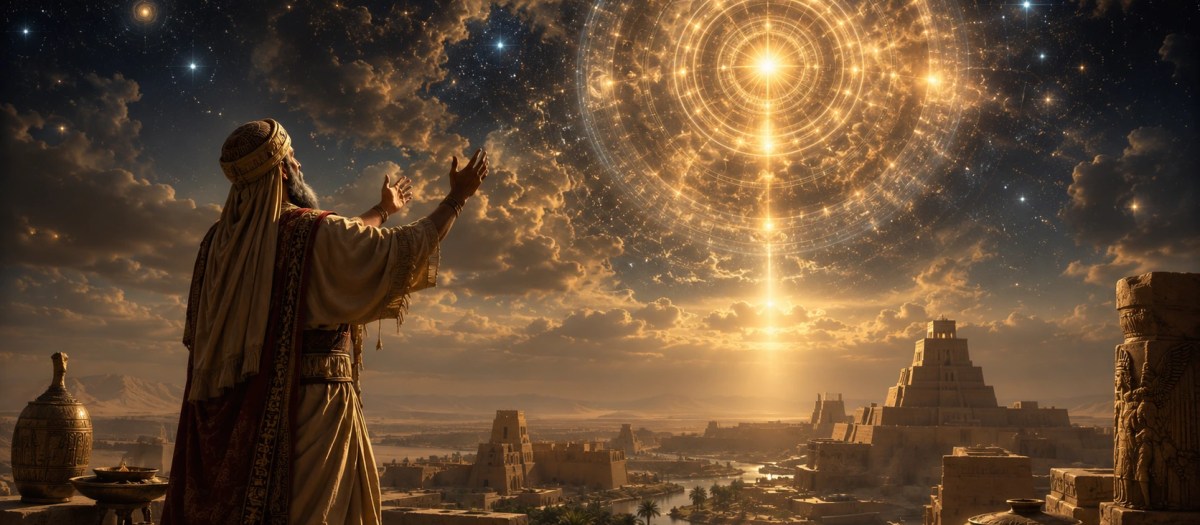
Quick answer: Astrology is a traditional system of interpreting the apparent positions of the Sun, Moon and planets as symbols connected with personality and events. A birth chart, or natal chart, maps those positions for a person’s date, time and place of birth. Beginners usually start with their Sun sign, Moon sign and rising sign, then explore the planets, zodiac signs, twelve houses and aspects. Astrology has a long cultural history, but scientific research has not established that natal charts predict personality or life outcomes.
Affiliate disclosure: This guide includes affiliate and referral links. Mystic Realm Blog may earn a commission if you purchase or book through them, at no extra cost to you.
Most people first encounter astrology through their Sun sign in a newspaper or app. A natal chart is more detailed: it places several celestial bodies around a circular diagram and assigns symbolic meanings to their positions. Reading one can feel confusing at first, so this article explains the main components in plain English, the information needed for a chart, where the traditions came from and how to interpret them critically.
What is astrology, and how is it different from astronomy?
Astrology is a system of divination or interpretation associated with celestial positions. Different traditions use different zodiacs, techniques and philosophical explanations. Astronomy is the scientific study of celestial objects using observation, physics and mathematical models. Both may refer to planets and stars, but they make different kinds of claims and use different methods for testing those claims.
You can enjoy astrology as symbolic storytelling or as a cultural tradition while recognising its evidential limits. The American Astronomical Society explains the distinction. Actual planetary positions can be calculated precisely, but that mathematical accuracy does not establish the personal predictions attached to them.
What is a birth chart?
A birth chart is an astronomical diagram of where selected celestial bodies appeared, in an astrologer’s chosen coordinate framework, at a stated date and time. Astrologers divide it into zodiac signs and houses, then interpret positions and angles as themes. Some focus on the natal chart alone, while others compare it with later planetary movements known as transits.
A useful distinction is between calculation and interpretation. Calculating where the Moon or Mars appeared is a legitimate astronomical task. Deciding that a planet therefore determines your relationships is an astrological belief, not a scientifically demonstrated conclusion. This guide explains the symbolic system without presenting the interpretation as a fact about your personality.

How do you create a birth chart for free?
Most online calculators ask for your date of birth, time of birth and birthplace. The birth location and time are important because the apparent sky and the chart’s angles change throughout the day. If you do not know your exact time, some placements can still be estimated, but the rising sign and house positions may be uncertain or unavailable.
- Step 1: Find your date of birth and the most accurate birth time available.
- Step 2: Enter the town or city of birth, rather than assuming your current location is equivalent.
- Step 3: Use a calculator that identifies its zodiac and house-system settings.
- Step 4: Write down your Sun, Moon and rising signs before attempting the rest of the wheel.
- Step 5: Compare the interpretation with your experience as a reflection prompt, not as a diagnosis or fixed destiny.
For a clear starting point, Astro.com’s free chart section offers chart drawings and explanatory options. The original post also recommended a Just Astrology Things chart calculator; check whether that specific calculator remains available before using it. Avoid posting somebody else’s birth time and place publicly without consent, and review any service’s privacy terms before entering personal details.
What are the Sun, Moon and rising signs?
Sun sign: your general identity theme
In mainstream Western natal astrology, the Sun is commonly interpreted as representing identity, direction or a person’s sense of self. Your Sun sign is usually determined by your birth date, although people born near sign boundaries may need an accurate date and time to confirm it. Horoscope columns often focus almost entirely on the Sun sign, which is why their descriptions can feel broad.
Moon sign: emotional symbolism
The Moon is commonly connected with emotions, habits, comfort and the inner world in modern astrology. Its zodiac position changes relatively quickly, so time and location may matter for births close to a sign change. This is symbolic language, not proof that someone with a particular Moon sign experiences emotions in a predetermined way.
Rising sign or Ascendant: the eastern horizon
The Ascendant is the point of the zodiac rising on the eastern horizon at the moment and place of birth, within the chosen astrological system. It is often interpreted as outward presentation, approach or first impressions. It changes quickly enough that an approximate birth time can produce the wrong result. If the time is unknown, do not simply guess your rising sign from your personality.
When astrologers refer to a person’s “Big Three”, they mean these Sun, Moon and rising placements. That phrase is an accessible starting point, but a traditional natal interpretation can include much more. The three signs are not scientific measurements of character, even though the underlying sky coordinates can be calculated.
What do the 12 zodiac signs mean?
| Sign | Element in Western astrology | Common interpretive themes |
|---|---|---|
| Aries | Fire | Initiative, action |
| Taurus | Earth | Stability, resources |
| Gemini | Air | Curiosity, communication |
| Cancer | Water | Home, care |
| Leo | Fire | Expression, creativity |
| Virgo | Earth | Detail, service |
| Libra | Air | Balance, relationships |
| Scorpio | Water | Intensity, change |
| Sagittarius | Fire | Exploration, meaning |
| Capricorn | Earth | Structure, responsibility |
| Aquarius | Air | Collective ideas, independence |
| Pisces | Water | Imagination, sensitivity |
These are interpretive keywords rather than fixed personalities. People share traits across categories, and no reliable scientific method has confirmed that being born under a zodiac sign determines temperament. Use the table to understand how astrologers speak about signs, not to judge what someone else must be like.
What do the planets mean in a natal chart?
Astrological interpretation attaches themes to the Sun and Moon as well as the planets. Although the Sun is a star and the Moon a satellite, astrologers often group them with the “planets” as interpretive bodies. Classical Western systems use the visible planets through Saturn; modern systems commonly include Uranus, Neptune and Pluto.
| Body | Common symbolic association |
|---|---|
| Sun | Identity and purpose |
| Moon | Feelings and habits |
| Mercury | Thinking and communication |
| Venus | Affection and values |
| Mars | Energy and assertion |
| Jupiter | Growth and philosophy |
| Saturn | Limits and responsibility |
| Uranus | Change and innovation |
| Neptune | Imagination and ideals |
| Pluto | Transformation and power |
The meanings are conventions of a particular tradition and often have exceptions. A planet appearing in a sign or house does not independently reveal your medical conditions, psychological profile or future. For example, someone might read “Mars in a fire sign” as a symbol of drive, but that is not a validated measure of aggression or motivation.
What do the 12 houses in astrology represent?
The houses divide a natal chart into twelve sectors connected with areas of life. Their positions depend on the birth time, place and chosen house system. Some common systems include Placidus, Whole Sign and Equal House; they can place planets in different houses. When comparing readings, use the same settings before assuming somebody has calculated the chart incorrectly.
| House | Common topic |
|---|---|
| 1st | Self and presentation |
| 2nd | Resources and values |
| 3rd | Learning and communication |
| 4th | Home and origins |
| 5th | Creativity and enjoyment |
| 6th | Routine and service |
| 7th | Partnership and cooperation |
| 8th | Shared resources and transformation |
| 9th | Study, beliefs and travel |
| 10th | Career and public role |
| 11th | Friendship and community |
| 12th | Retreat and hidden concerns |
These divisions are used to organise a symbolic reading. For example, a planet in the fourth house might prompt reflection on home or family, while one in the tenth might prompt thinking about work. It does not establish that the planet caused an event. The houses are also one reason that birth-time accuracy matters in many chart-reading systems.
What are aspects: conjunctions, squares, trines and oppositions?
An aspect is an angle between two chart positions. Western astrology assigns meanings to certain angular relationships. A conjunction is near zero degrees; a sextile near 60, a square near 90, a trine near 120 and an opposition near 180. Actual angles can be calculated, but the traditional labels “challenging” and “harmonious” are interpretations rather than measured forces controlling a person’s life.
Astrologers also use an orb, a permitted difference from the exact angle. Different schools choose different orbs, which can change which aspects appear on a chart. Beginners need not memorise every aspect immediately: identify a few of the strongest marked lines and learn what the chosen software calls them.
Tropical vs sidereal astrology: why can signs differ?
Western popular astrology usually uses the tropical zodiac, connected to the seasonal equinoxes. A sidereal zodiac uses a different reference related to stellar positions and is found in several traditions including forms of Indian astrology. The two zodiacs can produce different sign assignments for the same birth date, so apparent discrepancies are not necessarily a calculator error.
This distinction is important when comparing chart interpretations from different websites. Check the settings, house systems and birth time before deciding that a result is more “accurate”. Accurate calculation within a convention is distinct from proving the predictive assumptions of astrology.
How do you read a birth chart step by step?
- Check that the date, birthplace, time zone and birth time are correctly entered.
- Identify the zodiac system and house system used by the calculator.
- Begin with the Sun, Moon and rising sign, noting what each symbolises in that tradition.
- Look at Mercury, Venus, Mars and any other planet you are interested in.
- Find the houses and note which symbolic topics are emphasised.
- Consider one or two aspects, rather than attempting to interpret every line immediately.
- Write down your own reactions, including where descriptions do not fit.
For example, an astrologer might read a Sun placement as a broad theme of expression and a Saturn placement as a prompt to consider duties. You could use those as questions in a journal: “What responsibilities matter to me?” or “Where do I want to be more creative?” You need not accept that the planets caused those traits. A good interpretation should leave room for uncertainty and ordinary human variation.
Can astrology predict love, compatibility or careers?
Astrologers may use natal charts or synastry (comparisons of two charts) to discuss relationships. Others examine the tenth house or Saturn for work-related themes. However, there is no reliable scientific evidence that these techniques can determine whether a relationship will succeed, whether somebody is trustworthy or whether a career decision is right. Respect consent when discussing another person’s private life.
If a reading feels interesting, use it to formulate open questions rather than pass judgement. For example, ask what you value in a partnership, what you can communicate more clearly or which skills you want to develop. Do not use a chart to explain away abuse, reject medical advice, decide legal questions or make high-stakes financial choices.
Is astrology scientifically accurate?
No reliable scientific evidence supports astrology’s central claims that planetary positions at birth determine personality or predict personal outcomes. Astronomy can describe celestial movements with great accuracy, but that does not make horoscopes scientifically validated. The Planetary Society explains that astrology is a belief-based divinatory system rather than a science.
People may nevertheless find symbolic readings reflective or culturally meaningful. A common reason general horoscopes seem strikingly accurate is that broad descriptions can apply to many people; selective memory also makes memorable matches stand out. Noticing this does not mean a person must stop enjoying the tradition. It means claims about the physical world should be held to the same evidential standards as other factual claims.
Where did astrology come from?
Early forms of celestial divination developed in ancient Mesopotamia, where sky observations were connected with omens and political or religious concerns. Later Hellenistic astrologers developed natal chart techniques by combining influences from different cultural and philosophical settings. Astrology then evolved through Arabic, medieval European, Indian and other traditions. It is not a single unchanging system invented in one moment.
For a deeper look at the symbolic relationship between stars and esoteric ideas, our Hermeticism guide explains how later thinkers connected cosmic correspondences with philosophy and alchemy. Our article on occult symbols helps separate historical imagery from modern interpretations.
Which beginner astrology resources are useful?
A clear chart calculator and one introductory guide are enough to start. The original article linked to Parkers’ Astrology, a substantial illustrated guide. Check the edition and table of contents, because a large reference book may be less convenient than a short introductory chapter for your first chart.
This page also previously linked to Spiritual Blossom and a separate referral offer. These remain optional third-party services; compare their prices and descriptions and remember that a paid interpretation is not scientific proof. The previous external image banner and tracking pixel have been omitted from the refreshed content to avoid loading extra images unrelated to the article’s educational illustrations.
Astrology for beginners: frequently asked questions
What details do I need for a birth chart?
Your date, birth time and birthplace. An approximate or unknown time can affect the rising sign and houses, so label any uncertain information rather than guessing.
What is my Big Three in astrology?
Your Sun sign, Moon sign and rising sign. They are three commonly emphasised placements in modern Western natal astrology, each given different symbolic interpretations.
Why is my rising sign different across websites?
Check the birth time, time zone, location and zodiac or house-system settings. Errors in any of these can change chart angles; the rising sign is especially time-sensitive.
Is a birth chart different from a horoscope?
A natal chart is constructed for a specific time and place of birth. A popular horoscope usually offers a general interpretation for a Sun sign or other placement over a period. Neither has been scientifically validated as a method for predicting life outcomes.
Can two people with the same birthday have different charts?
Yes. Birth time and place affect chart angles and the house layout. Some celestial bodies also move far enough during a day to shift their placement near sign boundaries.
Can I learn astrology without buying a course?
Yes. A free chart calculator, a glossary and a notebook offer a starting point. Begin with a few placements and use reliable sources to understand what is a historical convention versus a tested claim.
Final verdict: understand the chart as a symbolic system
A birth chart can be an engaging way to explore the history and vocabulary of astrology, but it does not determine your future. Start with an accurately calculated chart, learn the Sun, Moon, rising sign, planets and houses, then interpret them thoughtfully rather than treating them as objective diagnoses. If you enjoy symbolic reflection, also try tarot reading for beginners, scrying or the history of Hermeticism.