

By Richard Clements
The story begins with a congregation looking up.
It was a church service somewhere in medieval Ireland, in what is now County Tipperary. Mass was underway when something unexpected happened outside the building.
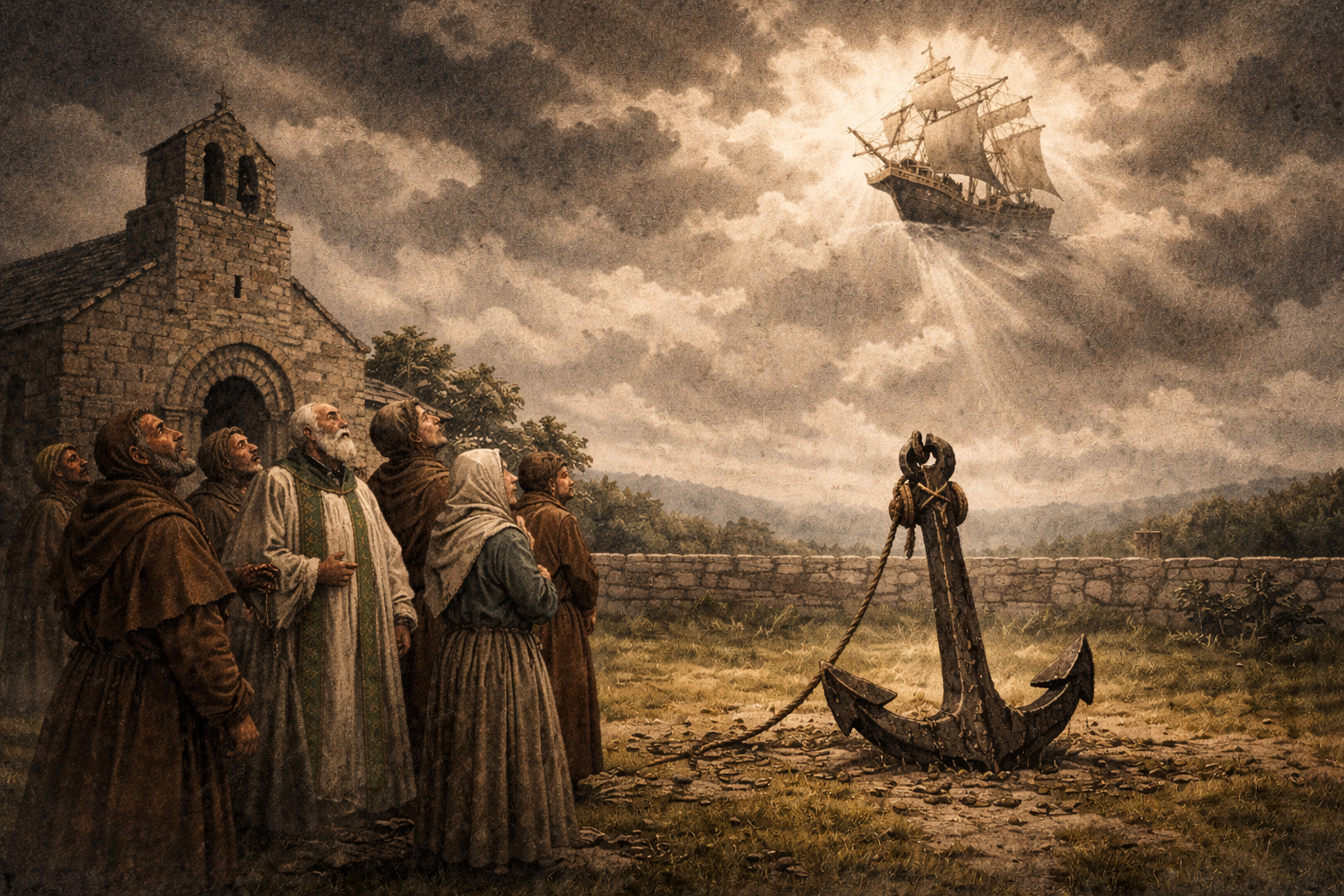
An anchor dropped from the sky.
Not a small object either, but the sort of anchor used by ships at sea. It fell into the churchyard and lodged firmly in the ground. For a moment the people present must have assumed it was some sort of accident, though how such a thing could fall from above is difficult to imagine.
Then someone noticed the chain.
It stretched upward into the air, disappearing into the clouds.
When the congregation stepped outside and followed the line with their eyes, they saw what was attached to it.
A ship.
Not drifting like a cloud or illusion, but moving slowly across the sky as though it were sailing through water.
The anchor had caught below and the vessel could not move on.
The crew, it seemed, were trying to retrieve it.
The Sailor on the Rope
According to the medieval account, one of the sailors climbed down.
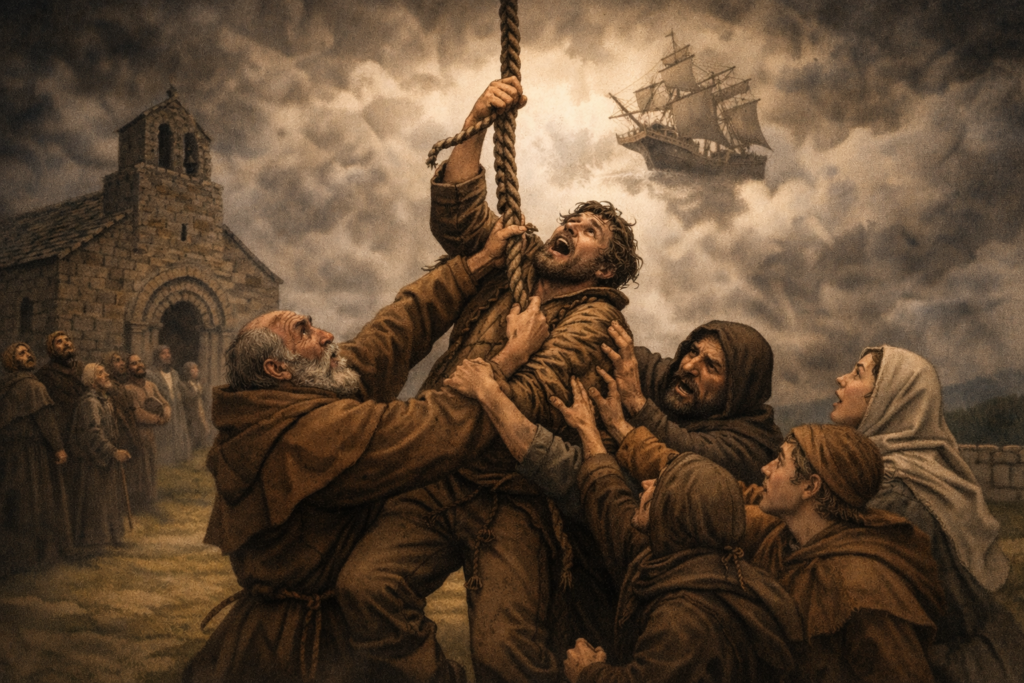
He descended carefully along the rope toward the ground, clearly intending to free the anchor. The people gathered in the churchyard watched him approach with a mixture of curiosity and suspicion.
Someone reached out.
Others followed.
Before long several people had grabbed hold of the man.
What happened next made the situation suddenly alarming.
The sailor began to struggle.
Not in the way a man might fight or panic, but in a way that suggested something far stranger. The chronicler who recorded the event wrote that he appeared to move like a drowning man. His arms flailed, his body twisted, and he seemed unable to breathe.
Those holding him quickly realised something was wrong and released their grip.
Freed from them, the sailor hurried back up the rope toward the vessel above.
The crew apparently understood the danger immediately. They cut the line.
The anchor remained where it had caught in the earth, but the ship itself drifted away across the sky until it disappeared from sight.
According to the story, the anchor was later kept inside the church as a reminder of what had happened.
Whether such an object truly existed is impossible to confirm, yet the detail has kept the tale alive for centuries.
The Chronicler Who Recorded the Story
The account survives because it was written down by a scholar named Gervase of Tilbury.
Gervase lived during the late twelfth and early thirteenth centuries and worked in the court of the Holy Roman Emperor Otto IV. His book Otia Imperialia is an unusual work even by medieval standards. It collects geography, natural history, folklore, and curious anecdotes from across Europe.
Some entries read like travellers’ tales. Others resemble early attempts at scientific observation.
The story of the flying ship appears among these curiosities.
Gervase does not present it as a miracle or a divine sign. Instead he describes it almost calmly, as though it were simply another strange feature of the world worth recording.
That tone is part of what makes the account so interesting today.
A Different Way of Understanding the Sky
To modern readers the story can sound almost like an early report of an unidentified aerial object. The imagery certainly feels familiar: a craft appearing unexpectedly, witnesses observing it briefly, then its disappearance before any explanation can be reached.
Medieval thinkers, however, approached the sky very differently.
For them the air above the earth was not empty space. It was a layered and mysterious region filled with winds, vapours, and forces that were only partly understood. Some writers even imagined that parts of the upper atmosphere behaved like an ocean.
Within that worldview the flying ship was not necessarily impossible.
It simply belonged to another realm.
Gervase hints at this when he describes the sailor struggling after being grabbed by the people below. The implication is that the air near the ground was too dense for him. Just as a human would struggle underwater, the sailor appeared unable to breathe properly in the heavier atmosphere of the earth.
In other words, the crew of the vessel were navigating a different sea.
Echoes in Medieval Folklore
The idea of ships moving through the air was not entirely unique to Ireland.
A similar belief appears in parts of medieval France, where people spoke of a mysterious aerial realm called Magonia. According to folklore, ships from this cloud-kingdom sailed through the sky and sometimes appeared during violent storms.
The ninth-century archbishop Agobard of Lyon wrote about these beliefs while attempting to refute them. In his treatise De Grandine et Tonitruis he complained that some villagers believed storm-makers cooperated with sailors from this sky-world.
Agobard dismissed the idea as superstition.
Yet the fact that he addressed the belief at all suggests that stories of aerial ships were circulating widely enough to concern church authorities.
Seen in that context, the Irish account begins to look less like a single strange anecdote and more like part of a broader tradition in which the sky was imagined as a navigable realm.
A Story That Refuses to Disappear
What actually inspired the story is impossible to know.
Perhaps it began as a piece of folklore. Perhaps it was based on a misunderstanding of some atmospheric phenomenon. Medieval chronicles are full of accounts where observation and imagination overlap.
Yet the image at the centre of the tale remains remarkably vivid.
An anchor falling from the clouds.
A rope stretching upward into empty air.
A ship gliding across the sky as though it were sailing through an invisible ocean.
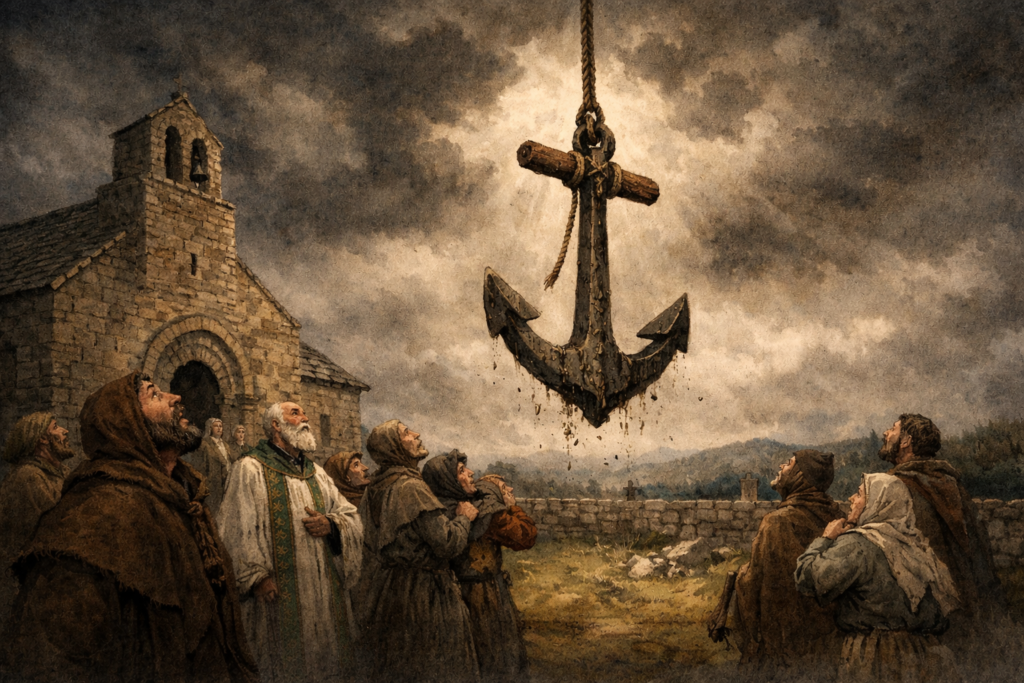
It is easy to see why the story still captures attention today.
It reminds us that curiosity about the heavens is not a modern habit. People have always watched the sky and wondered what might be passing overhead.
Most of the time the answer was simple: clouds, birds, perhaps a distant storm.
But once, according to a thirteenth-century chronicler, it looked very much like a ship trying to retrieve its anchor from an Irish churchyard.
References
Agobard of Lyon. De Grandine et Tonitruis (On Hail and Thunder), c.815.
Gervase of Tilbury. Otia Imperialia, c.1211–1215.
Daston, Lorraine & Park, Katharine. Wonders and the Order of Nature 1150–1750. Zone Books, 1998.
Le Goff, Jacques. The Medieval Imagination. University of Chicago Press, 1988.
Further Reading
Westwood, Jennifer & Simpson, Jacqueline. The Lore of the Land. Penguin, 2005.