
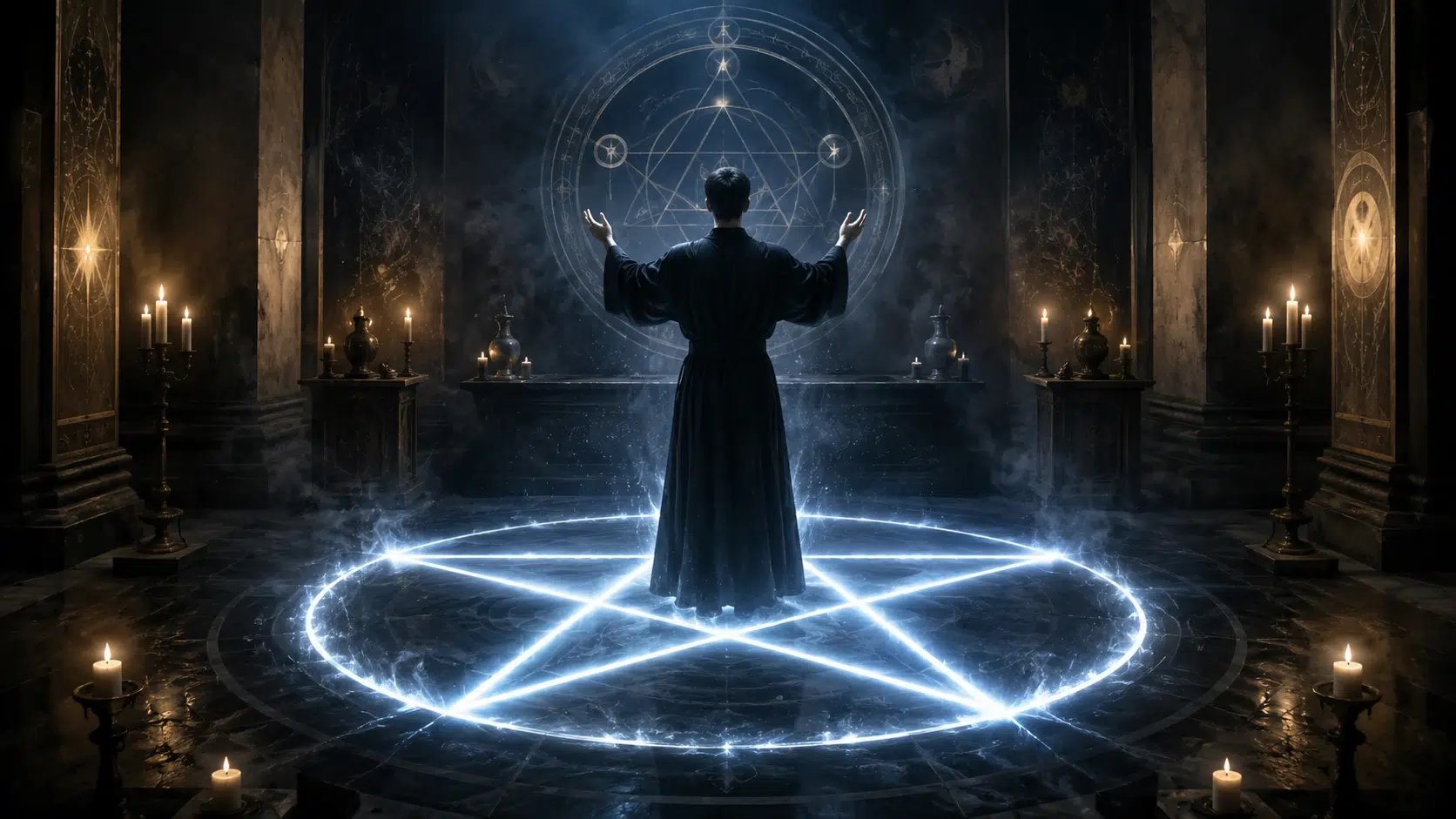
The Lesser Banishing Ritual of the Pentagram, often shortened to the LBRP, is one of the best-known protective rituals in Western ceremonial magic. It is commonly used to clear unwanted energy, create sacred space, centre the practitioner, and prepare for deeper magical or spiritual work.
In this guide, we’ll explore what the LBRP is, where it comes from, what each part of the ritual means, and how the ritual is traditionally performed step by step. I first came across the LBRP around ten years ago, and this article brings together the key history, symbolism, practical instructions, and recommended resources for anyone wanting to understand it properly.
Quick Summary: What Is the LBRP?
The Lesser Banishing Ritual of the Pentagram is a ceremonial magic ritual used for protection, purification, grounding, and spiritual preparation. It includes the Qabalistic Cross, the drawing of banishing pentagrams in the four directions, the vibration of divine names, and the invocation of the archangels Raphael, Gabriel, Michael, and Uriel.

History of the LBRP
The LBRP has its origins in the Hermetic Order of the Golden Dawn, a magical society founded in the late 19th century. The Golden Dawn synthesized various elements of Western esoteric traditions, including Kabbalah, astrology, alchemy, and ceremonial magic. The LBRP was designed as a foundational practice for members, serving as a daily ritual to develop discipline, focus, and spiritual protection.
For more background, read my guide to the Hermetic Order of the Golden Dawn.
One of the key figures in the development of the Golden Dawn and the LBRP was Samuel Liddell MacGregor Mathers. Along with William Wynn Westcott and William Robert Woodman, Mathers was instrumental in shaping the teachings and rituals of the order. The LBRP, in particular, reflects Mathers’ deep understanding of Kabbalistic and Hermetic principles.
You may also find my article on Hermetics useful for understanding the wider philosophy behind the LBRP.
Purpose and Benefits of the LBRP
The primary purpose of the LBRP is to banish negative energies and influences from the practitioner’s environment. This includes not only external entities or energies but also internal states of mind that may hinder spiritual progress. By performing the LBRP regularly, practitioners can:
- Create a protected and purified space for magical and spiritual work
- Strengthen their connection to the divine and their higher self
- Develop concentration, visualisation, and ritual skills
- Balance and harmonise their energy bodies
Many practitioners use the LBRP as a daily grounding and clearing practice. Others use it before meditation, tarot work, spirit communication, paranormal investigation, or more advanced ceremonial rituals. The key is consistency, focus, and respect for the ritual structure.
If you’re also interested in paranormal investigation and spiritual protection, you may find my guide to the best ghost hunting equipment useful, especially for tools used during cleansing, protection, and investigation work.
Before You Perform the LBRP
The LBRP is not something to rush through casually. Before beginning, choose a quiet space, make sure you feel calm and grounded, and take time to understand the words, symbols, and visualisations involved.
If you are new to ceremonial magic, treat the ritual as a spiritual discipline rather than a performance. Start slowly, learn the structure, and focus on clarity, respect, and intention.
Components of the Lesser Banishing Ritual of the Pentagram (LBRP)
The LBRP consists of several key components, each with its own symbolic and practical significance. These components include:
- The Qabalistic Cross
- The Formulation of the Pentagrams
- The Evocation of the Archangels
- The Qabalistic Cross (Closing)
The Qabalistic Cross
The ritual begins and ends with the Qabalistic Cross, a short invocation that centres and aligns the practitioner with the divine. This invocation involves the following steps:
- Touch the forehead and say, “ATEH” (Thou art).
- Touch the chest and say, “MALKUTH” (The Kingdom).
- Touch the right shoulder and say, “VE GEBURAH” (and the Power).
- Touch the left shoulder and say, “VE GEDULAH” (and the Glory).
- Clasp the hands at the chest and say, “LE OLAM, AMEN” (forever, Amen).
This invocation draws on Kabbalistic concepts and establishes a connection with the divine light, creating a protective shield around the practitioner.
The Formulation of the Pentagrams
The next step involves drawing pentagrams at the four cardinal points (east, south, west, and north) while invoking specific divine names. Each pentagram is drawn in the air with the index finger or a ritual dagger, visualizing it as a blazing blue flame. The steps are as follows:
- Face East and draw a banishing pentagram (starting from the bottom left point, moving to the top, and so on).
- Thrust the finger or dagger into the center of the pentagram and vibrate “Yod-He-Vav-He” (YHVH).
- Turn to the South and repeat the pentagram drawing while vibrating “ADONAI.”
- Turn to the West and repeat the pentagram drawing while vibrating “EhEIEh.”
- Turn to the North and repeat the pentagram drawing while vibrating “AGLA.”
- Return to the East and complete the circle by connecting the pentagrams with a line of light.
These divine names are powerful invocations that call upon different aspects of the divine, reinforcing the protective barrier created by the pentagrams.
The Evocation of the Archangels
After formulating the pentagrams, the practitioner invokes the archangels to guard the four quarters. This step involves visualising the archangels standing at each cardinal point, their presence forming a circle of protection around the practitioner:
- Extend the arms to form a cross and say:
- “Before me, Raphael” (visualise a figure in yellow robes, holding a caduceus, associated with air).
- “Behind me, Gabriel” (visualise a figure in blue robes, holding a chalice, associated with water).
- “On my right hand, Michael” (visualise a figure in red robes, holding a sword, associated with fire).
- “On my left hand, Uriel” (visualise a figure in green robes, holding a sheaf of wheat, associated with earth).
- Say: “For about me flames the pentagram, and within me shines the six-rayed star.”

This invocation not only calls upon the protective forces of the archangels but also aligns the practitioner with the elemental forces and the divine presence within.
The Qabalistic Cross (Closing)
The ritual concludes with a repetition of the Qabalistic Cross, sealing the protective circle and reinforcing the connection to the divine.

Performing the LBRP: Step-by-Step Instructions
Now that we’ve covered the components and symbolism of the LBRP, let’s go through the complete ritual step-by-step:
- Stand facing East, in a calm and quiet space. Take a few deep breaths to centre yourself.
- Perform the Qabalistic Cross:
- Touch your forehead and say, “Ateh.”
- Touch your chest and say, “Malkuth.”
- Touch your right shoulder and say, “ve-Geburah.”
- Touch your left shoulder and say, “ve-Gedulah.”
- Clasp your hands at your chest and say, “le-Olahm, Amen.”
- Formulate the Pentagrams:
- Face East. Draw a banishing pentagram in the air with your finger or dagger.
- Thrust into the center and vibrate “Yod-He-Vav-He.”
- Turn to the South. Draw the banishing pentagram, vibrate “Adonai.”
- Turn to the West. Draw the banishing pentagram, vibrate “Eheieh.”
- Turn to the North. Draw the banishing pentagram, vibrate “Agla.”
- Return to the East, connecting the pentagrams with a line of light.
- Evocation of the Archangels:
- Extend your arms to form a cross. Say:
- “Before me, Raphael.”
- “Behind me, Gabriel.”
- “On my right hand, Michael.”
- “On my left hand, Uriel.”
- Visualise the archangels surrounding you, forming a protective circle.
- Say: “For about me flames the pentagram, and within me shines the six-rayed star.”
- Extend your arms to form a cross. Say:
- Perform the Qabalistic Cross (Closing):
- Touch your forehead and say, “Ateh.”
- Touch your chest and say, “Malkuth.”
- Touch your right shoulder and say, “ve-Geburah.”
- Touch your left shoulder and say, “ve-Gedulah.”
- Clasp your hands at your chest and say, “le-Olahm, Amen.”
Symbolism of the Lesser Banishing Ritual of the Pentagram (LBRP)
The LBRP is rich in symbolism, drawing from Kabbalistic, Hermetic, and elemental traditions. Understanding these symbols enhances the ritual’s effectiveness and deepens your spiritual connection.

The Qabalistic Cross
The Qabalistic Cross centres the practitioner within the Tree of Life, a central symbol in Kabbalah representing the divine structure of the universe. The invocation aligns the practitioner with the divine light, establishing a sacred space and reinforcing their connection to the divine.
- Ateh: Represents the divine presence, the higher self.
- Malkuth: The physical world, the Kingdom.
- ve-Geburah: The divine power and strength.
- ve-Gedulah: The divine glory and magnificence.
- le-Olahm, Amen: Eternity, affirming the connection with the eternal divine light.
The Pentagrams
The pentagrams are powerful symbols of protection and control over the elements. In the LBRP, the banishing pentagrams are used to clear the space of unwanted influences and establish a purified environment.
- Yod-He-Vav-He (YHVH): The Tetragrammaton, representing the divine presence and authority.
- Adonai: A name of God, meaning “Lord,” associated with divine authority.
- Eheieh: “I Am,” the divine name associated with the Kether, the highest point on the Tree of Life.
- Agla: An acronym for “Ateh Gibor Le-Olam Adonai,” meaning “Thou art mighty forever, O Lord.”
The Archangels
The archangels represent the four cardinal directions and the elemental forces, providing protection and balance.
- Raphael: Associated with the element of air, representing intellect and communication.
- Gabriel: Associated with the element of water, representing emotions and intuition.
- Michael: Associated with the element of fire, representing courage and transformation.
- Uriel: Associated with the element of earth, representing stability and strength.
You may also find my article on Archangels useful for understanding who they are.
The Six-Rayed Star
The six-rayed star, or hexagram, symbolises the union of the divine and the human, the macrocosm and the microcosm. It represents the practitioner’s divine nature and the integration of their higher self with their earthly existence.
Resources for Further Study
For those interested in exploring the LBRP and related practices further, here are some recommended resources:
Books
- “The Golden Dawn” by Israel Regardie: This comprehensive work details the teachings and rituals of the Hermetic Order of the Golden Dawn, including the LBRP.
- “Modern Magick” by Donald Michael Kraig: A practical guide to modern ceremonial magic, including step-by-step instructions for the LBRP and other foundational rituals.
- “The Middle Pillar” by Israel Regardie: Explores the Kabbalistic foundations of Western esoteric practices, including detailed explanations of the LBRP.
- “High Magic: Theory & Practice” by Frater U.D.: Provides an in-depth look at various magical practices, including the LBRP.
Websites
- Hermetic Order of the Golden Dawn: The official site of the modern Golden Dawn, offering resources and information on their teachings and practices.
- Esoteric Archives: A collection of historical texts and manuscripts related to Western esotericism, including the Golden Dawn materials.
Online Communities
- Reddit: r/Occult: A subreddit for discussions on all aspects of occultism, including ceremonial magic and the LBRP.
FAQs About the Lesser Banishing Ritual of the Pentagram
What is the Lesser Banishing Ritual of the Pentagram used for?
The LBRP is commonly used for protection, energetic cleansing, grounding, and preparing sacred space before magical or spiritual work.
Is the LBRP suitable for beginners?
Yes, many people learn the LBRP early in ceremonial magic, but beginners should study the symbolism and pronunciation carefully before using it regularly.
How often should you perform the LBRP?
Some practitioners perform it daily, while others use it before rituals, meditation, divination, or spiritual work.
Do you need tools to perform the LBRP?
No physical tools are required. Some practitioners use a wand, dagger, or athame, but the ritual can also be performed using the hand and focused visualisation.
What does LBRP stand for?
LBRP stands for Lesser Banishing Ritual of the Pentagram.
Final Thoughts on the Lesser Banishing Ritual of the Pentagram
The Lesser Banishing Ritual of the Pentagram is a foundational practice in Western ceremonial magic, offering protection, purification, and spiritual alignment. By understanding its history, symbolism, and steps, practitioners can harness its power to create a sacred space for their magical and spiritual work.
Regular practice of the LBRP not only enhances your ritual skills but also strengthens your connection to the divine, providing a solid foundation for your spiritual journey. Whether you are a beginner or an experienced practitioner, the LBRP is an invaluable tool in your magical arsenal.