

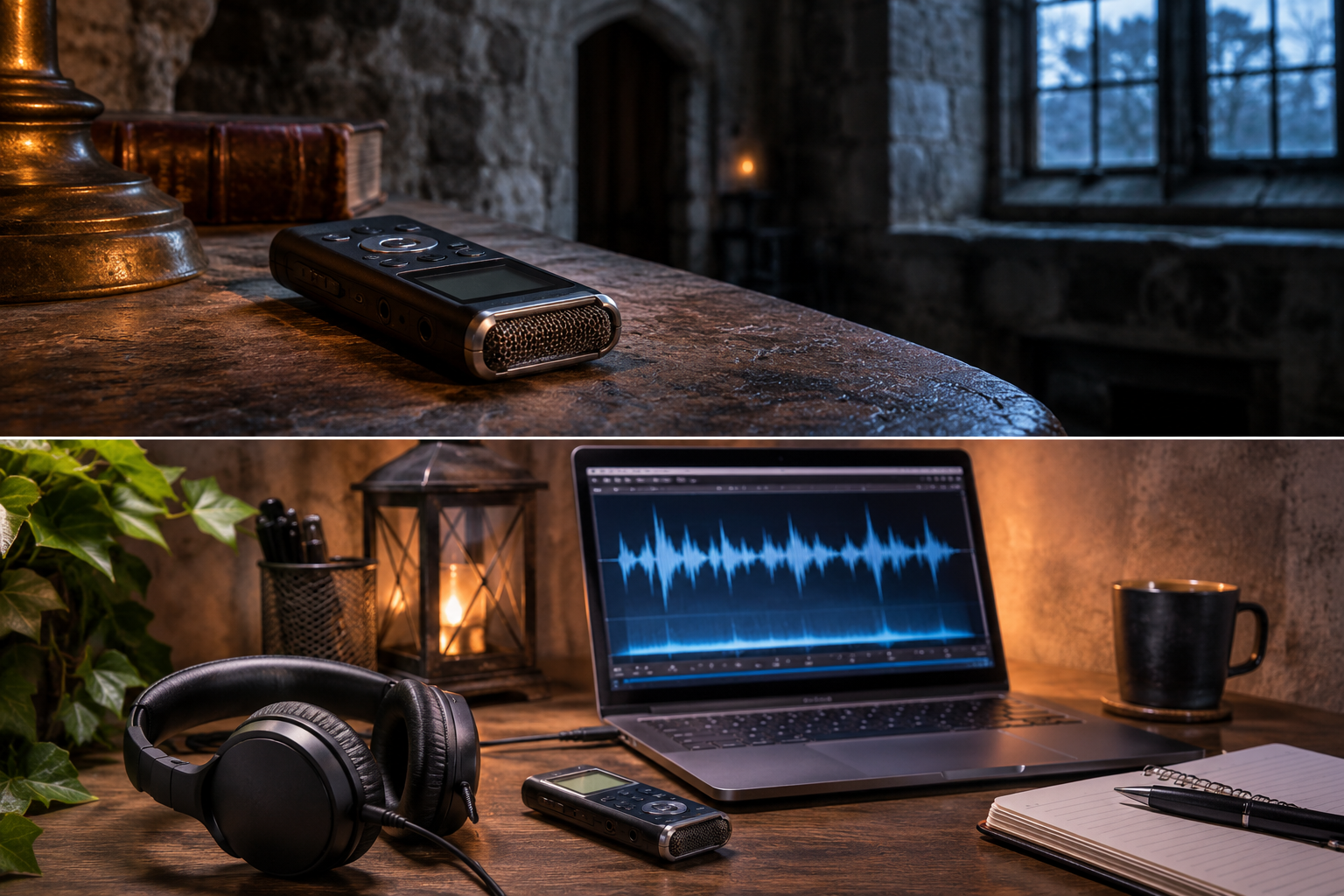
Quick answer: To record an EVP (electronic voice phenomenon), choose a quiet location where you have permission to investigate, make an uncompressed audio recording if possible, state the date and conditions, ask a question, and leave a pause to capture the room’s sound. Afterwards, listen to the original recording with headphones, check possible ordinary sources, and document anything unusual. An unexplained sound is not, by itself, evidence of a spirit.
If you have watched a ghost-hunting investigation, you have probably seen the moment an investigator plays back a recording and hears what sounds like a whispered answer. That moment can be compelling. But how do you record EVP properly, and how can you tell a meaningful anomaly from a passing car, a teammate’s whisper or a misleading noise? This beginner-friendly guide covers a repeatable recording method, practical settings, audio analysis and the mistakes worth avoiding.
You do not need an expensive kit to get started. If you want to compare dedicated devices after learning the method, see our best EVP recorders for ghost hunting guide. This article focuses on how to use a recorder thoughtfully, rather than which model to buy.
What is EVP in ghost hunting?
EVP stands for electronic voice phenomenon. In paranormal investigation, the term usually describes a voice-like sound found on an audio recording that the investigator does not remember hearing at the time. Some enthusiasts interpret these sounds as potential spirit communication. Others point to ordinary sources such as distant speech, radio interference, recording artifacts or the tendency to hear familiar words in ambiguous noise.
The historical fascination with EVP is often associated with Friedrich Jürgenson and later paranormal researchers who interpreted unexpected sounds on recordings as voices. Those stories are part of EVP’s history, but they do not demonstrate that a recording device can capture the voices of the dead. There is no established scientific evidence that EVP recordings are spirit communication. A careful investigation treats a voice-like sound as an observation to examine, not a conclusion reached in advance.
What equipment do you need to record EVP?
A basic setup can be remarkably simple. The important thing is knowing what your equipment records and controlling the conditions around it.
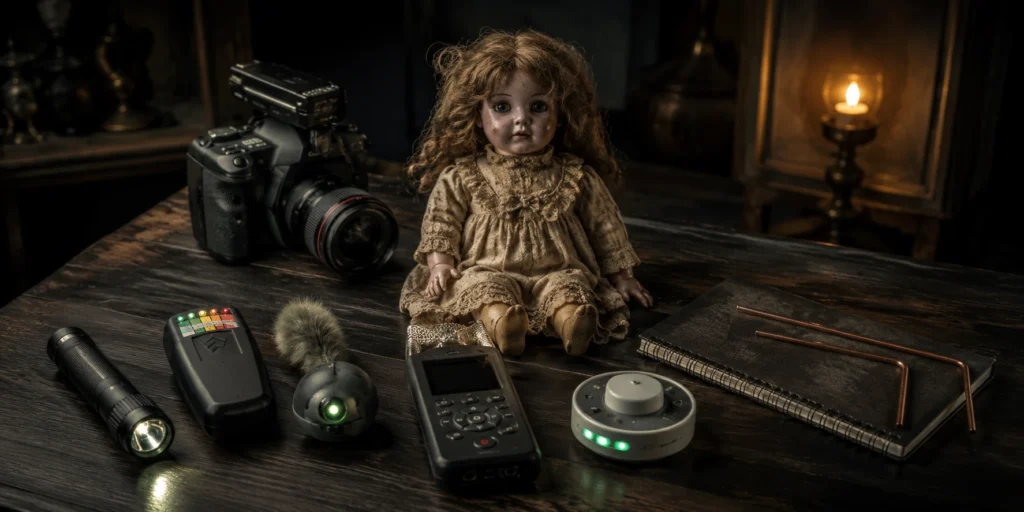
- A digital audio recorder or smartphone: A phone can be sufficient for a first test. A dedicated recorder may offer easier controls, longer sessions, adjustable recording levels and WAV files.
- Headphones: Closed-back headphones make quiet details easier to review without turning up speakers and introducing more noise.
- Fresh batteries and free storage: Confirm both before entering the location.
- A stable surface or small tripod: Avoid holding or touching the recorder during a session, because fingers and clothing produce misleading noises.
- A notebook or timestamped log: Record the location, participants, sound sources and unusual moments.
- Optional second recorder: Two independently positioned devices can help establish whether a sound was present in the environment.
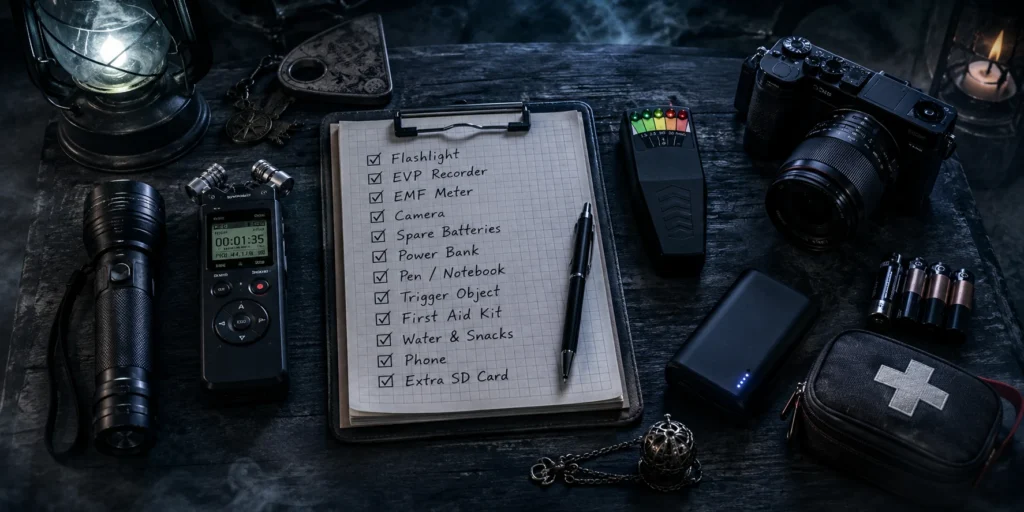
For packing advice beyond audio, use our ghost hunting equipment checklist. You can also explore the wider ghost hunting equipment guide if you are assembling your first investigation kit.
What recording format and settings are best?
Where available, choose WAV/PCM recording at 44.1 or 48 kHz and 16-bit or 24-bit depth. These are practical, standard-quality recording settings; choosing much higher sample rates does not make paranormal voices more detectable. Compressed formats such as MP3 may be convenient, but they discard audio information and can add artifacts that complicate later interpretation.
Set the input level so ordinary nearby speech is recorded clearly without clipping or distorting. If the device has automatic gain control, understand that it may boost background hiss dramatically during silent periods. Disable unnecessary voice activation, filters or automatic enhancement where possible, so the original audio remains consistent. Do a short test recording and listen back before the full session.
How to record EVP: a step-by-step session
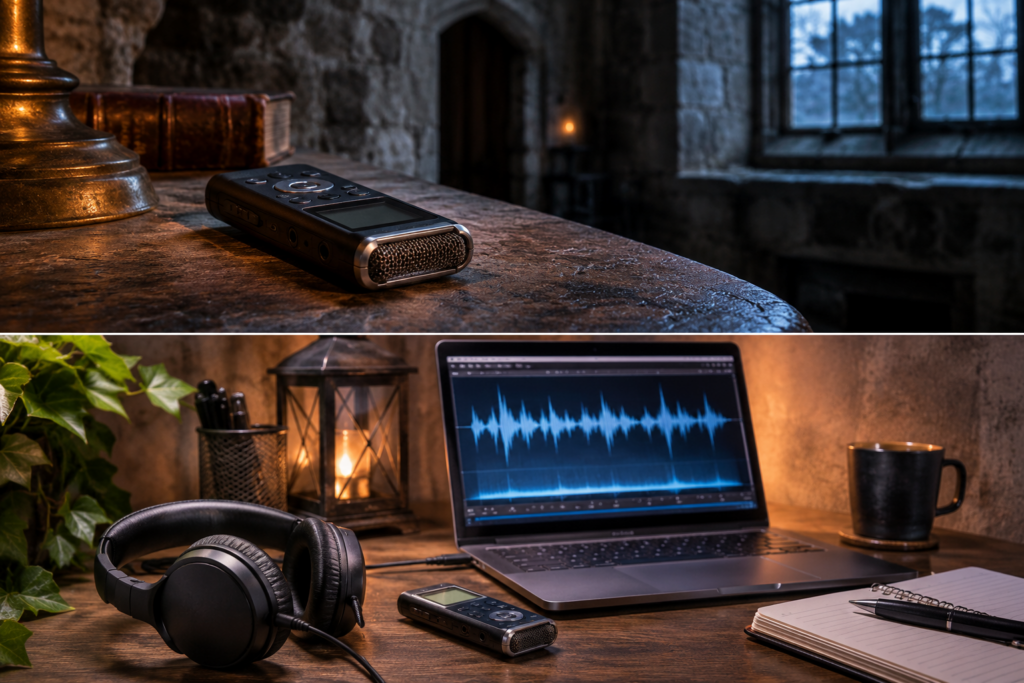
The most useful EVP session is one that another investigator could understand and repeat. Try the following eight-step method on your next permitted investigation.
Step 1: Choose a quiet, safe and legal location
Start in a room with minimal traffic, heating noise, televisions, radio signals or conversations. A home room can be better for practice than a famous haunted building full of visitors. Obtain permission from the property owner or operator, respect restricted areas and do not trespass. Record people only with appropriate consent and be mindful of privacy rules when sharing clips.
Step 2: Survey the environment before you begin
Listen for ventilation, pipes, creaking floors, birds, people outdoors and electrical hum. Walk around the space and note where sounds are coming from. Record 60–90 seconds of normal room ambience before you ask questions. This baseline can help you identify recurring noises later.
Step 3: Place and test the recorder
Put the recorder on a stable surface, away from clothing, cables, phones and anything that may vibrate. Keep it away from open windows if there is wind. Make a test clip while one person speaks from the expected questioning position. Play the clip back, confirm the voice is clear and check that the levels are not distorting.
Step 4: Announce the session details
State the date, time, location (if appropriate to disclose), number of participants, equipment and environmental conditions at the start. For example: “EVP test, upstairs room, two people present; fan switched off; no other visitors known.” If a dog barks or a door opens later, note that too. These details turn an interesting recording into something you can actually review.
Step 5: Ask one clear question at a time
Use a calm, normal speaking voice. Short, open-ended questions are usually easier to document than lengthy speeches. For example: “Is there anyone here?” or “Is there a sound you would like us to hear?” Avoid threatening, provoking or claiming authority over anyone or anything. Questions are simply part of the paranormal experiment; there is no established evidence that an unseen presence can hear or answer them.
Step 6: Leave deliberate silent intervals
After each question, allow about 15–30 seconds of quiet recording. The precise interval is a practical choice, not a scientifically validated spirit-response window. Everyone should remain still and avoid whispering. If anyone coughs, shifts a chair or speaks, call it out immediately so the noise is documented in the recording.
Step 7: Keep sessions manageable
For beginners, sessions of roughly 10–20 minutes are easier to log and review than one continuous recording lasting hours. These are workflow suggestions rather than rules. It is perfectly reasonable for a session to produce no unusual audio. Do not keep repeating questions until a noise seems to fit what you want to hear.
Step 8: End, back up and label your recording
Say that the session has ended, stop the recording and make a backup before editing. Give the original file a descriptive name, such as 2026-11-11_upstairs-room_session-01.wav. Save a copy in a separate folder and work only on duplicates. Keep the original intact for comparisons and future review.
What questions should you ask during an EVP session?
There is no proven list of questions that produces EVP. However, consistent questions make observations easier to compare between sessions. Try a few of the following without changing your method each time:
- “Can you tell us a name?”
- “Is there a sound you would like us to notice?”
- “Can you make one clear sound after this question?”
- “Is there something about this room we should know?”
- “Would you like us to stop asking questions?”
Mark the exact moment each question was asked. If you run a session with other investigators, establish a rule that nobody talks during the pause. Do not suggest a particular answer before reviewing any unusual clip; expectation can influence what people believe they hear.
How do you analyse an EVP recording accurately?
Reviewing audio is where many apparent EVP discoveries are made—and where interpretation can go wrong. A repeatable review process reduces the risk of turning ordinary noise into an assumed message.
- Listen to the full original recording first. Take notes without immediately labeling sounds as words.
- Log the timestamp. Record the exact point, what you heard and any known noises in the room.
- Replay at normal speed. Listen with headphones before applying filters, amplification or speed changes.
- Compare surrounding audio. Check the seconds before and after the sound for footsteps, clothing noise, distant conversation or repeated mechanical noises.
- Check a second source. If another recorder or camera was running, compare timestamps and audio. A sound on both devices may have been environmental; a sound on only one may be local to that device.
- Use processing sparingly. If you apply EQ or noise reduction, export it as a separate labelled copy and always retain the unprocessed file.
- Invite blind feedback. Ask other listeners what they hear without telling them your interpretation first. Compare their independent responses.
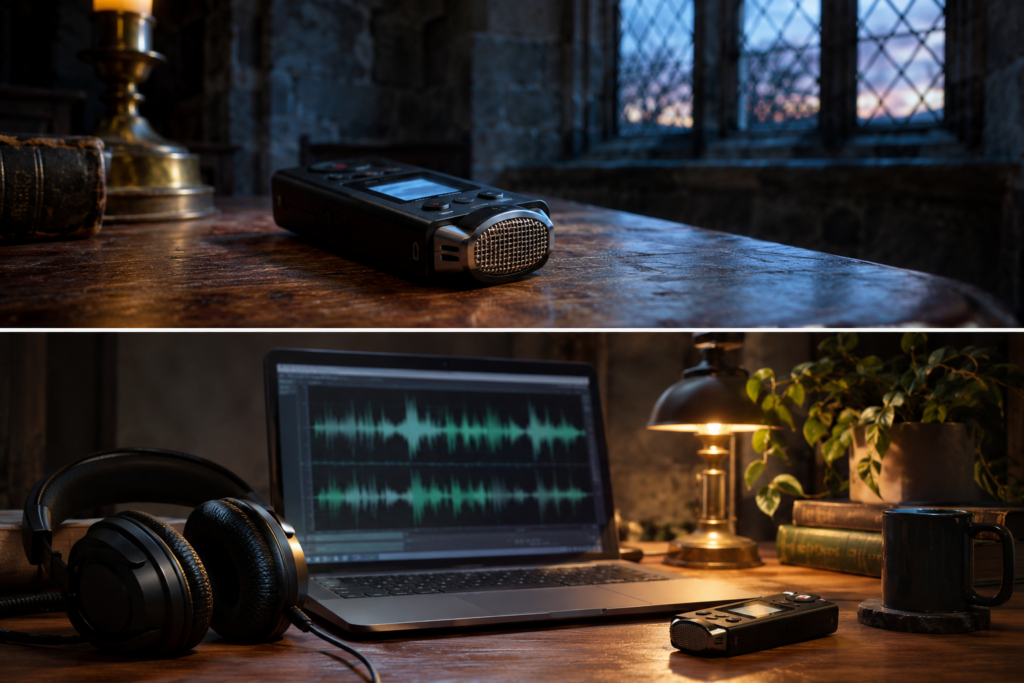
A waveform shows how audio amplitude changes over time; a spectrogram shows how sound energy is distributed by frequency. Neither display can establish that a voice belongs to a spirit. Free tools such as Audacity can help you inspect and export audio, but the result still depends on your recording conditions and interpretation.
Can EVP be explained by audio pareidolia and recording artifacts?
Yes. Many voice-like recordings have plausible non-paranormal explanations. Audio pareidolia is the experience of hearing recognisable words or patterns in ambiguous sound. The brain is highly effective at searching for speech, particularly when someone suggests what a faint phrase is supposed to say.
Other common sources include distant conversations travelling through walls, traffic, wireless interference, wind striking a microphone, compression distortion, breathing, stomach noises, handling sounds, and an automatic recording level that boosts room hiss. Some recorders also generate electrical or mechanical artifacts. A faint sound that seems like a sentence after heavy filtering may be less meaningful than the unprocessed clip suggests.
Try a simple control test: record several minutes of silence in the same room when no EVP session is being conducted. Compare how many apparent whispers you notice in the control and experimental clips. This does not conclusively prove or disprove paranormal claims, but it encourages a more disciplined assessment.
Are Class A, B and C EVP recordings scientific classifications?
You may see enthusiasts describe EVP clips as Class A, B or C. These labels are informal community shorthand, generally intended to distinguish apparently clear sounds from more ambiguous ones. They are not a validated scientific grading system, and different groups may use the terms differently. If you share a clip, it is more helpful to provide the original audio, timestamp, conditions and independent interpretations than to rely on a class label.
Should you use a spirit box instead of an EVP recorder?
The two tools involve different methods. A standard audio recorder captures sounds present at its microphone. Many spirit boxes rapidly scan broadcast radio frequencies or generate audio, adding another substantial source of speech fragments and noise. That makes interpretation particularly challenging. If you want to understand the differences and limitations, read our spirit box comparison guide.
Some investigators also use EMF meters or motion sensors alongside audio. Those instruments measure physical changes relevant to their sensors; they do not independently verify a spirit’s presence. Keeping each device’s purpose clear improves the quality of your notes.
Seven common EVP recording mistakes to avoid
- Whispering while someone else records. Even a distant whisper can sound strange through a sensitive microphone.
- Holding the recorder. Handling noise and friction can resemble murmurs.
- Recording beside fans, radios or phones. Avoid uncontrolled sound sources where possible.
- Using voice activation. It can miss quiet audio or clip the start of a sound.
- Overprocessing recordings. Aggressive noise reduction can introduce unnatural, speech-like artifacts.
- Leading your listeners. Telling someone “it says get out” before playback biases the response.
- Discarding unsuccessful sessions. Quiet recordings and ordinary explanations matter for an honest investigation log.
A simple EVP session log you can copy
Before recording, create a small log with these fields. It makes later investigations easier to compare and helps prevent details being filled in from memory.
| Field | What to record |
|---|---|
| Date and start time | Local time and session duration |
| Location | Room or area, with permission noted |
| Participants | How many people and where they stood |
| Equipment | Recorder, format, gain and mic position |
| Conditions | Weather, doors, HVAC and nearby activity |
| Notable timestamps | Questions, movements and unusual sounds |
| Review outcome | Likely cause, uncertainty and follow-up |
If you are investigating with objects placed around the room, our guide to trigger objects for ghost hunting explains how to document them separately. When video is also running, the night vision camera guide can help you think about matching visual and audio timestamps.
Frequently asked questions about recording EVP
Can I record EVP with my phone?
Yes. A smartphone can capture clear environmental audio and is a reasonable starting point. Use an offline recording app that preserves original files where possible, silence notifications and place the phone on a stable surface. Test the microphone first and avoid claiming a dedicated recorder is inherently more paranormal-sensitive.
Do EVP sessions work better at night?
There is no reliable evidence that nighttime increases the chance of spirit communication. Night investigations may feel quieter and more atmospheric, but darkness can introduce practical safety problems and make routine sounds harder to identify. Choose a time when you can control background noise safely.
How long should I wait between EVP questions?
Around 15–30 seconds is a manageable interval for a beginner’s structured session. It gives the recording time to capture ambient sounds while making timestamps easier to review. The timing is an organisational choice, not a proven requirement.
Does a clear voice on a recording prove a ghost was present?
No. Even clearly speech-like audio can originate from people, broadcasts, sound reflections or equipment behavior. A clip is most useful when its original recording, environmental context and alternative explanations are available.
Can I enhance an EVP recording to hear it better?
You can use gentle amplification or filtering on a copy to inspect a detail, but never replace the original. Enhancement can also create artifacts or make ambiguous sounds seem like words. Explain every adjustment when publishing audio.
Final verdict: what makes an EVP recording worth reviewing?
A worthwhile EVP investigation is not measured by how many mysterious voices someone claims to find. It is measured by clear audio, careful logging, repeatable methods and a willingness to rule out ordinary causes. Start with the equipment you already own, record a quiet baseline, ask measured questions and keep the original files. If a genuinely puzzling sound appears, share the context rather than presenting it as proof.
When you are ready to build a reliable audio kit, compare features and budgets in our EVP recorder buying guide. For a balanced view of other investigation methods, our article on thermal cameras and ghost hunting examines the limits of interpreting instrument readings. Curiosity is part of paranormal research; documenting uncertainty is what makes the process more useful.
Further reading and recording resources
- Audacity — free audio editing and waveform review software.
- NIDCD: How Do We Hear? — background on the human hearing system.
- Google Search Central: Creating helpful, reliable, people-first content — editorial guidance for online publishers.