

Mothman is a legendary winged, red-eyed figure associated with a wave of reported sightings around Point Pleasant, West Virginia, beginning in November 1966. The story later became connected to the Silver Bridge disaster of 15 December 1967, but no reliable evidence shows that a supernatural creature predicted or caused the tragedy. Mothman remains an important American folklore figure, not a scientifically confirmed animal.
The most interesting question is not simply “Was Mothman real?” It is how a handful of frightening reports, local journalism, ordinary wildlife possibilities and later paranormal storytelling combined into a legend that still shapes Point Pleasant’s identity.
Quick answer: People reported seeing an unusually large flying figure near the former TNT industrial area. Explanations include misidentified birds, difficult night-time viewing and the growth of a shared narrative. The sightings are historically documented as reports; the creature’s extraordinary features have not been independently verified.
Where did the Mothman story begin?
The familiar account centres on 15 November 1966. Two young couples—Roger and Linda Scarberry, and Steve and Mary Mallette—described an unsettling encounter while driving near the disused North Power Plant and wartime munitions area north of Point Pleasant. They said they saw a large, greyish, human-like bird or winged figure, with unusually bright red eyes. According to later summaries of their testimony, the figure appeared to pursue their car as they drove away.
The following day’s Point Pleasant Register brought the story into local public view under a headline describing a man-sized bird or creature. The exact terminology matters: the first reporting did not establish an identified species, and the name “Mothman” developed amid the publicity. The Smithsonian Center for Folklife and Cultural Heritage traces this local history and its later cultural legacy.
The location also helped the story take hold. The former military-industrial landscape had empty buildings, wooded roads and little light. Such places can be genuinely unsettling after dark—and can make identifying an unexpected animal difficult.
What was the TNT area?
The “TNT area” was a disused World War II munitions site, with concrete bunkers and adjacent wildlife habitat. It was not an underground supernatural laboratory, despite inventions found in some online retellings. Reconstructing the geography is useful because many accounts depend on the visibility, road layout and wildlife that observers might have encountered.
Mothman sightings timeline: the key dates
| Date | Reported or documented event | How to interpret it |
|---|---|---|
| 15 Nov 1966 | Scarberry and Mallette couples report a large winged figure near the former TNT site. | The initial eyewitness claim; not physical proof of a new species. |
| 16 Nov 1966 | Local newspapers publish reports of the encounter. | Establishes the story’s early public record. |
| Late 1966–1967 | Further winged-creature reports and rumours circulate across the region. | Individual reliability varies; accounts may influence each other. |
| 15 Dec 1967 | The Silver Bridge collapses over the Ohio River, killing 46 people. | A documented tragedy with an identified engineering cause. |
| 1975 | John Keel publishes The Mothman Prophecies. | Important to the legend’s paranormal framing; not an independent biological record. |
| 2002 onwards | Film adaptations, festivals and tourism broaden the story. | Demonstrates cultural impact, not confirmation of sightings. |
The West Virginia Encyclopedia describes a cluster of reports and the association with writer John Keel. It is worth resisting the temptation to treat every later retelling as an independent incident.
What did witnesses actually describe?
Recurring descriptions include wings, an unusually large body, red eyes and flight without obvious wing movement. But reports are not uniform. Some emphasised a bird-like shape; others a humanoid silhouette. This variation matters. If several observers use different comparisons, later writers may combine them into a single creature with more precise anatomy than any witness could establish.
The important distinction: a witness may sincerely remember a six-foot figure, but perceived height, distance and speed during a brief night-time encounter are estimates. An unusual shape seen in headlights cannot reliably yield measurements unless there are known points of comparison.
Did Mothman have glowing red eyes?
Bright red eyes are among the legend’s best-known details. Animal eyes can reflect artificial light, an effect called eyeshine. Colour and brightness depend on lighting, viewpoint, anatomy and the observer’s perception. A strong red reflection may feel supernatural without requiring self-generated light. Audubon considers how night birds and eyeshine could influence reports, while also acknowledging the strange combination of details witnesses described.
Could the creature keep pace with a speeding car?
Accounts often describe extraordinary speed. However, seeing something apparently move alongside a car does not allow an accurate speed calculation unless the distance and relative movement are known. Under low light, people may misjudge a nearby object against a changing background. We should record the claim rather than turn it into an established flight-speed statistic.
Was Mothman an owl, crane or unknown bird?
Ornithologists and sceptical investigators have proposed familiar birds. Sandhill cranes are tall, with broad wings and a reddish area near the head; owls can appear large, silent and strangely shaped in darkness. The challenge is finding one explanation that fits all the reported details, not just one or two.
| Explanation | Why it is considered | Limitation |
|---|---|---|
| Owl | Nocturnal habits, quiet flight, eyeshine and broad wings. | Reported size and posture may not match normal owl dimensions. |
| Sandhill crane | Large body, long wings and red head patch. | Some reported behaviour and local observations remain debated. |
| Other bird or misperception | Low-light viewing, fear and unfamiliar wildlife can distort shape and scale. | Specific sightings cannot be reconstructed from recollections alone. |
| Unknown species | Could in principle account for unusual observations if independently documented. | No verified specimen, diagnostic genetic evidence or unambiguous repeated record. |
| Supernatural entity | Reflects later omen and paranormal interpretations. | Not a testable explanation for the physical reports. |
The bird hypothesis is not a verdict on every witness. It is a reminder to consider common wildlife before assuming an unprecedented creature. For a broader explanation of how observation and testable evidence differ, read our cryptozoology and evidence guide.
How did Mothman become linked to the Silver Bridge collapse?
On 15 December 1967, the Silver Bridge carrying US Route 35 between Point Pleasant and Ohio collapsed into the Ohio River. Forty-six people died. The tragedy belongs first to the victims and their families, not to a monster story.
Later interpretations connected the recent sightings with a warning, an omen or a paranormal sequence. Yet the official US National Transportation Safety Board investigation determined that the collapse began with the failure of an eyebar component in the bridge’s suspension system. The fracture developed through stress corrosion and corrosion fatigue over time.
That documented mechanical explanation is essential. The fact that unusual sightings preceded a disaster does not show that they predicted it. People often notice and remember striking coincidences after a tragic event; this retrospective pattern is a familiar feature of omen folklore.
Did anybody record a specific warning beforehand?
Stories that a figure anticipated the disaster became prominent through subsequent interpretations. To assess any precise prediction, ask for a date-stamped account demonstrably recorded before the collapse, the exact wording of the forecast, and proof it was not altered retrospectively. Without that, the proposition remains a post-event interpretation.
What did John Keel add to the Mothman legend?
Journalist and author John Keel’s 1975 book The Mothman Prophecies brought together local creature reports with stranger claims involving unusual communications, unidentified flying objects and mysterious visitors. The book became an influential work of paranormal literature and helped turn a regional story into a broader mythology.
This is where careful source separation becomes useful. “People in the region reported a winged figure” is a different claim from “a winged being is interdimensional” or “the being warned residents of an engineering disaster”. Each needs its own evidence, and later stories cannot be used to retrospectively prove the first.
Readers interested in how mysterious aerial claims change through retelling may also enjoy our discussion of aliens and unexplained aerial phenomena and the contributed medieval account Ships in the Clouds.
Did the Mothman legend spread beyond West Virginia?
Reports and images of similar winged figures have appeared in other regions, especially online. Connections between them are sometimes based primarily on resemblance to the famous Point Pleasant description. The key questions are whether each story has an independent original source, whether it predates exposure to the Mothman legend, and whether contemporary photographs provide enough information to identify what was recorded.
Point Pleasant itself has embraced the creature as cultural heritage. The statue, museum and events show how an unusual local story can become part of civic identity. The Smithsonian Folklife article is especially valuable here because it treats the legend as a living piece of community storytelling, not simply a claim awaiting scientific proof.
How would researchers investigate a modern Mothman report?
- Obtain the original testimony. Ask the observer to describe the shape, movement, light source and timeline without supplying the term “Mothman” first.
- Document viewing geometry. Record distance, angle, horizon and reference objects that might make the figure appear larger than it was.
- Check birds and aircraft. Examine likely species, migration, flight patterns, wildlife records and nearby aviation activity.
- Preserve original media. Avoid analysing only an enlarged social-media crop; obtain the source file and footage before and after the alleged event.
- Separate independent reports. Confirm whether witnesses heard about each other’s claims before offering descriptions.
- Leave an honest result. “Unidentified bird-like shape” can be a sound conclusion. An inability to identify a single image is not evidence of a new species.
Our guide to photographic orbs and camera artefacts offers further examples of why apparently remarkable images can have ordinary origins; the same careful approach applies to distant aerial figures.
Mothman frequently asked questions
Is Mothman real?
The reports and the folklore are real historical and cultural phenomena. There is no independently verified biological or supernatural evidence confirming Mothman as the extraordinary creature of later depictions.
When was Mothman first reported?
The most famous early reports date to November 1966 around Point Pleasant, West Virginia. A widely reported encounter occurred on 15 November; local press coverage followed immediately.
Did Mothman cause the Silver Bridge collapse?
No evidence supports that. The NTSB documented structural failure associated with fatigue and corrosion, and the disaster killed 46 people.
What animal is Mothman most often compared with?
Owls and sandhill cranes are among the commonly suggested explanations. Neither automatically resolves every account, and the extraordinary features remain unverified.
Can you visit Mothman-related locations?
Point Pleasant has sites connected to the legend, including visitor attractions. Verify current access and opening times locally, and never enter derelict industrial areas or restricted land to recreate a sighting.
Why are Mothman’s eyes red?
That is how numerous accounts and later art describe them. Reflected artificial light in animals’ eyes is a possible mundane explanation; no confirmed source establishes a unique biological mechanism for Mothman.
Final verdict: a documented legend, not a documented monster
Mothman’s staying power comes from the intersection of dramatic testimony, West Virginia’s distinctive landscape, creative literature and a community that adopted its strange visitor. The most convincing way to tell the story is to preserve those layers without confusing them. There are eyewitness reports worth studying, ordinary wildlife explanations worth testing and a tragic bridge collapse with a known mechanical cause. None alone proves the supernatural version of the legend.
Sources and further reading
- Smithsonian Center for Folklife and Cultural Heritage — Mothman and Point Pleasant.
- West Virginia Encyclopedia — Mothman.
- Audubon — Is the Mothman of West Virginia an Owl?.
- National Transportation Safety Board — Collapse of US 35 Highway Bridge.
- Academic folklore research — The Mothman: The Migration of a Local Legend.
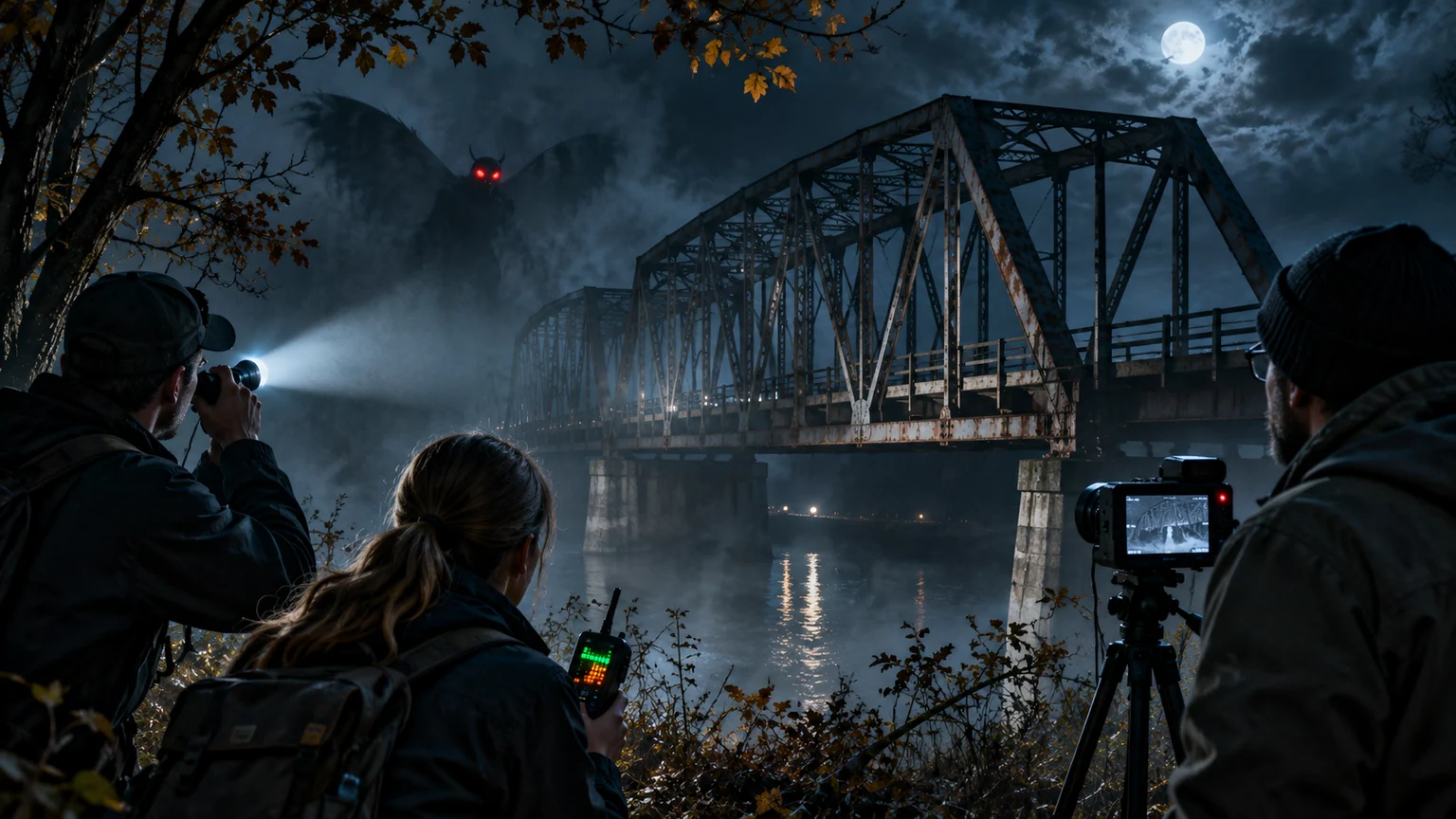
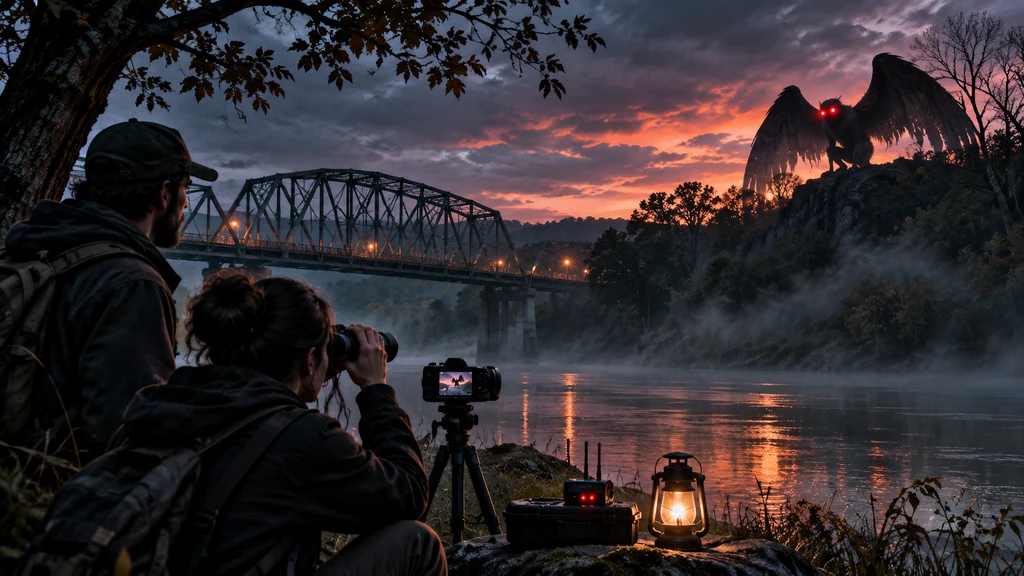
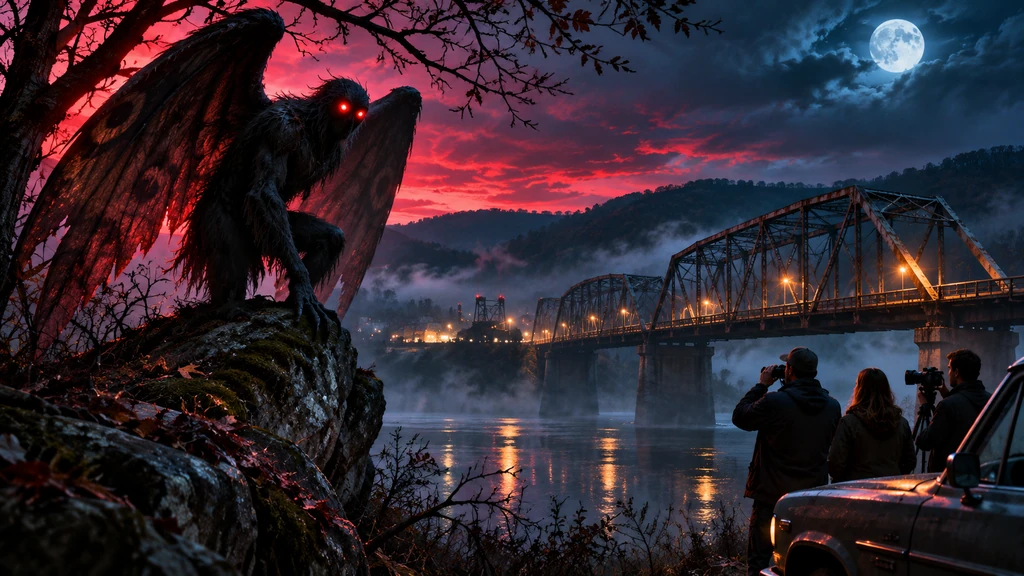
Image disclosure: The illustrations are newly created fictional editorial scenes, not authentic images of Mothman or documentary photographs of Silver Bridge.