

Cryptozoology is the search for and study of creatures whose existence has been reported but not scientifically established. These alleged animals, called cryptids, range from the Loch Ness Monster and Bigfoot to unfamiliar big cats, mysterious winged figures and regional folklore creatures. Their stories are fascinating, but a compelling sighting is not the same as a verified species.
This guide explains what cryptozoology means, how its history differs from zoology and folklore, which famous cases deserve a closer look, and what actually counts as credible evidence. It is designed for curious readers who enjoy the mystery without having to suspend critical thinking.
Quick answer: cryptozoology is an area of popular investigation and folklore rather than a recognised scientific discipline with a validated set of methods. A cryptid may eventually turn out to be a real, misidentified or newly described animal, a story shaped by culture, an unusual observation, or a deliberate hoax. Each claim needs to be assessed individually.
What does cryptozoology mean?
Cambridge Dictionary defines cryptozoology as attempting to find, describe and study creatures known from stories or reports but whose existence has not been demonstrated. The term combines ideas of the hidden or unknown with the study of animals. A cryptid is the purported creature; a cryptozoologist is someone who investigates claims about it.
The useful distinction is between the subject of a claim and the method used to test it. Searching for evidence of an unrecorded animal can involve ordinary zoological fieldwork, but accepting blurry footage or legends as proof without independent checks is not reliable science. A local account can have enormous cultural value without demonstrating a biological species.
Is a cryptid the same as a mythical creature?
Not exactly. Some cryptids are presented as ordinary but elusive animals: a large lake organism, an unknown primate or an unusually sized cat. Others, such as a shape-changing werewolf or a supernatural omen, are usually better understood within folklore or religious tradition. The categories overlap because stories evolve over time; an account of an unusual animal can accumulate paranormal elements as it is retold.
Our guides to werewolf legends and the Beast of Bodmin Moor demonstrate the difference: the former is primarily a body of traditions and historical beliefs, while the latter invites questions about real wildlife, escaped animals and identification.
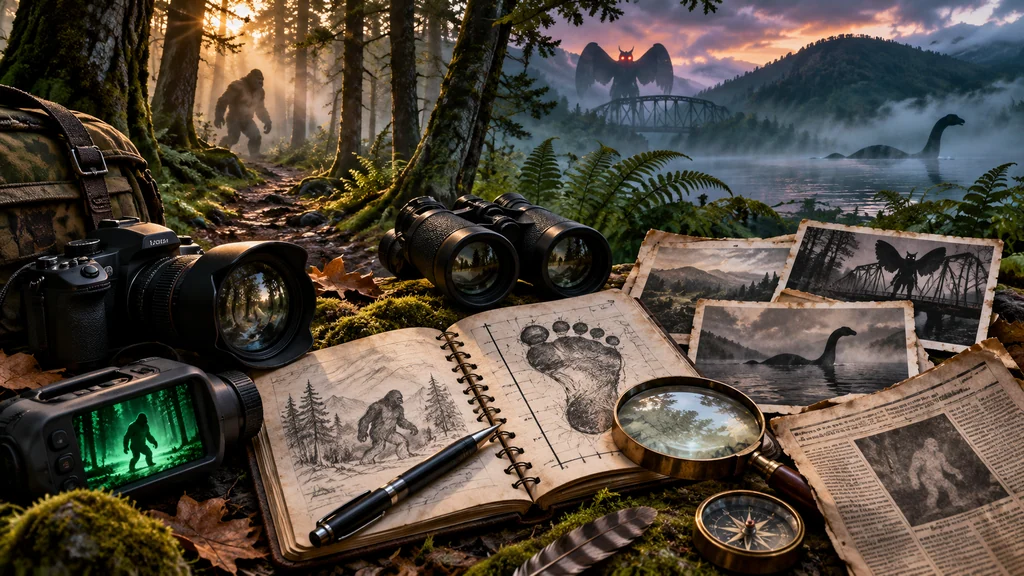
What types of cryptids do people report?
| Broad type | Well-known examples | Useful questions |
|---|---|---|
| Lake and water creatures | Loch Ness Monster; alleged sea serpents | What is the water depth, ecology and visibility? Could waves, boats or known animals explain the observation? |
| Large terrestrial animals | Bigfoot; reported mystery big cats | Would a breeding population leave tracks, remains, DNA or consistent camera evidence? |
| Winged or aerial figures | Mothman; thunderbird-type reports | What was the lighting and distance? Were known birds considered? |
| Livestock-linked predators | Chupacabra | Are injuries and blood-loss claims supported by veterinary examination? |
| Folkloric or supernatural beings | Werewolves; spectral hounds | Is the story reporting an animal, a religious belief or an uncanny experience? |
The categories are an editorial way to compare stories, not a zoological classification. Consider spectral black-dog folklore or fairy traditions: a legend may reveal how people make sense of place, fear and experience, even if it cannot be tested as an animal claim.
How did cryptozoology become popular?
Tales of strange animals existed long before the word cryptozoology became common. Travellers’ accounts, natural histories, sailors’ stories and regional oral traditions all contain unfamiliar creatures. In the twentieth century, books, newspapers, television and later online forums connected otherwise separate reports and helped turn local legends into internationally recognised cryptid identities.
Modern cryptozoology is often associated with Belgian-French zoologist Bernard Heuvelmans, who helped popularise the search for purported hidden animals. Yet the popularity of a story is distinct from its evidential strength. A printed account may establish that a claim existed by a particular date without confirming what caused the experience.
A practical historical test: track the earliest retrievable version of a story, separate what a witness actually reported from what later authors added, and compare dates across independent sources. A vivid modern retelling is not necessarily an independent sighting.
What evidence would prove an unknown animal exists?
Strong evidence should be independently examinable, have a known origin and allow alternative explanations to be tested. For a proposed animal species, a specimen, diagnostic biological material or consistently documented observations are much more informative than an isolated anecdote. That does not mean witness testimony is worthless; it means testimony is a starting point for questions, not the end of an investigation.
| Evidence type | What it can establish | What it cannot establish alone |
|---|---|---|
| First-hand testimony | What a person remembers or believes they saw | Species identity or the absence of misperception |
| Photograph or video | A recorded shape or event, if original files and context are available | True size, distance or identity without supporting data |
| Footprints and casts | The shape and position of an impression | Who or what made it, or whether it was staged |
| Hair, tissue or eDNA | Potential species information, if collected and analysed correctly | Proof of a cryptid if contamination or known species explain the result |
| Animal remains or diagnostic specimen | Physical evidence that experts can examine and compare | A new species until identification and independent review are complete |
Why photographs alone often fail
A single ambiguous silhouette loses its scale when the camera’s position, focal length and distance are unknown. Movement blur, compression, reflection and deliberate editing create additional problems. Ask for the original file and metadata, several frames before and after the alleged creature appears, a clear landmark and an independent witness’s account written before public discussion influenced it.
What about environmental DNA?
Environmental DNA, or eDNA, is genetic material organisms leave in water, soil or other environments. Scientists can sample it and compare sequences with reference databases. Its strengths include detecting traces of organisms that are difficult to observe; limitations include sampling coverage, contamination and incomplete reference data. The University of Otago’s 2019 Loch Ness eDNA project found abundant eel DNA but no DNA evidence supporting plesiosaurs in its samples. It did not demonstrate that giant eels exist.
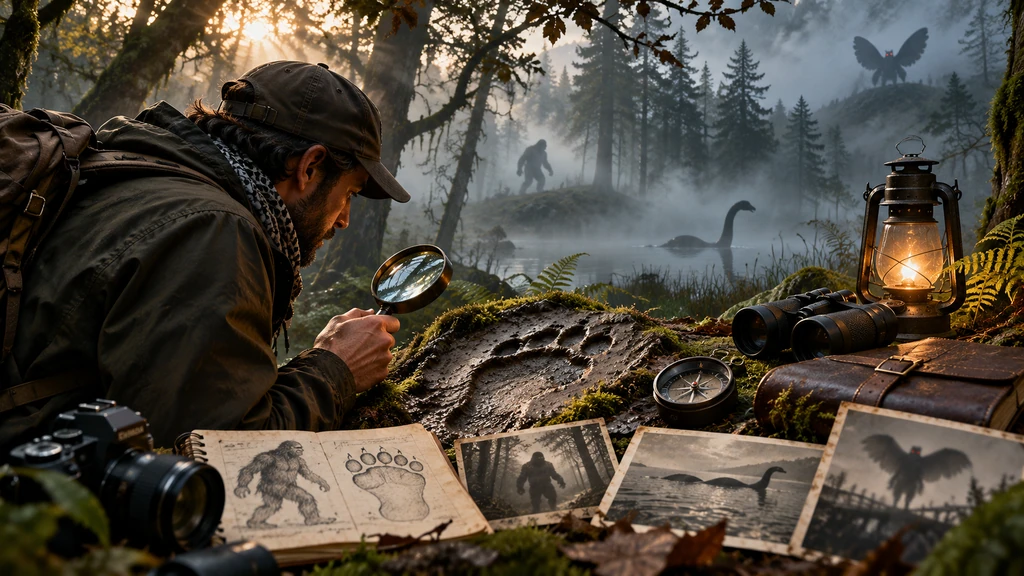
How should you investigate a cryptid report?
- Record the observation promptly. Note the time, precise location, weather, light level, viewing direction and duration. Capture the witness’s original wording without suggesting a preferred answer.
- Establish scale. Photograph nearby fixed objects, measure estimated distances, and avoid treating guesses about height or speed as verified measurements.
- Preserve originals. Keep unedited video and audio, original photograph metadata and a clear record of who handled files or samples.
- Research local wildlife and context. Check birds, mammals, water conditions, travel routes and possible mechanical sources. A good investigation actively tries to disprove its first hypothesis.
- Check independent records. Were other observers already aware of the story? Do accounts independently match details that could not be guessed from publicity?
- Seek qualified analysis. Wildlife biologists, veterinarians, geologists or imaging specialists may identify mundane causes that enthusiasts miss.
- Report uncertainty honestly. Label an observation unexplained only when the available evidence is insufficient; unexplained is not synonymous with paranormal.
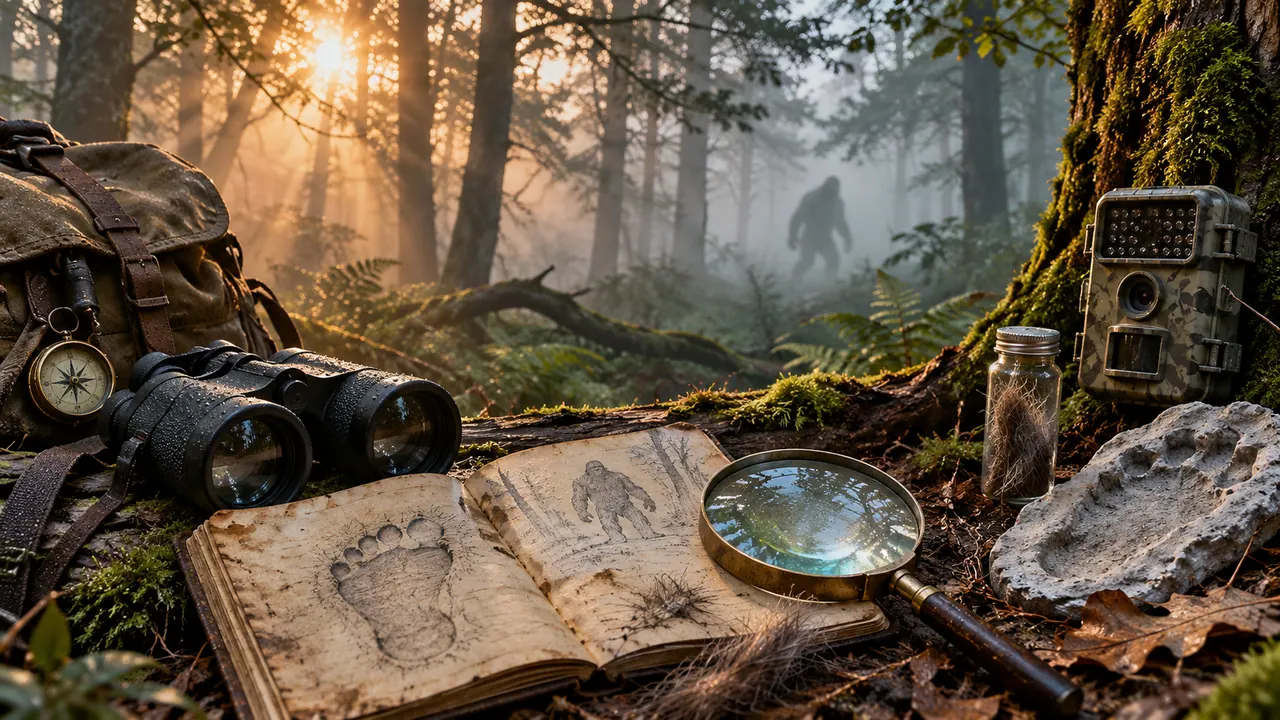
A simple field kit might include a camera, binoculars, scale reference, torch, notebook, power bank and suitable clothing. Our investigation equipment checklist covers useful record-keeping basics, although cryptid fieldwork often needs wildlife-specific methods and permissions.
Famous cryptid cases: what makes each distinctive?
Mothman: when a local sighting becomes a modern legend
Reports of a large, red-eyed winged figure around Point Pleasant, West Virginia, became prominent in November 1966. Their association with the fatal Silver Bridge collapse in December 1967 was developed in later storytelling. The bridge disaster has a documented structural cause, not evidence of a supernatural warning. The Smithsonian Folklife account is useful for understanding the creature’s local significance.
The Loch Ness Monster: where folklore meets environmental science
Loch Ness has generated modern sightings, disputed photographs and repeated searches. The famous 1934 “surgeon’s photograph” was eventually exposed as a hoax, while the eDNA survey provided a testable scientific angle. The unanswered details of particular eyewitness experiences do not overturn the absence of persuasive evidence for a giant unknown creature.
The Chupacabra: one name, changing descriptions
Reports linked to the name chupacabra became widely known in Puerto Rico in 1995. Early depictions were upright, spiny and alien-like; later mainland US accounts often showed hairless four-legged canids. The transformation is a particularly interesting example of folklore adapting as stories and imagery circulate. McGill University’s Office for Science and Society examines the case history and possible misidentifications.
Bigfoot, mystery cats and the wider field
Bigfoot stories carry a different evidential challenge: a breeding population of large mammals would ordinarily leave multiple kinds of biological traces over time. For a respectful perspective on the cultural relationship between nature and such stories, see our contributed piece Bigfoot and the Green Man. British reports of large cats, including the Beast of Bodmin Moor, should be assessed using local wildlife and physical evidence rather than assuming they are impossible or confirmed.
Why do cryptid legends survive?
Cryptid stories express fascination with wilderness, unexplored places and the possibility that familiar landscapes still hold surprises. They also give communities distinctive identities. A town may be closely associated with a legend through museums, storytelling, festivals and tourism; that cultural impact can be documented even when the alleged animal is unverified.
Psychology matters, too. The mind rapidly interprets ambiguous shapes in difficult light. Repeated exposure to a famous image may influence later recollections. A dramatic description tends to spread farther than a cautious correction. These factors do not mean witnesses are dishonest; ordinary perception and memory can be sincere and mistaken at the same time.
Common mistakes when researching cryptids
- Counting repeated stories as new sightings: syndicated reports and retellings can originate from a single witness.
- Assuming every mystery is biological: legends, dreams, hoaxes and symbolic stories need different approaches.
- Ignoring negative results: a search that finds known animal DNA still contributes useful knowledge.
- Using illustrations as evidence: artistic reconstructions must be labelled clearly.
- Disturbing wildlife or private land: no photograph justifies unsafe access or harming an animal.
Cryptozoology frequently asked questions
Is cryptozoology a science?
It is not generally recognised as a scientific discipline. Specific claims can, however, be tested using established scientific methods such as wildlife surveys, genetics, photography analysis and archival research.
Have any cryptids been proven real?
Animals once little known to outsiders have certainly been scientifically described, but an unfamiliar animal is not automatically proof of a specific legendary creature. A claimed cryptid needs evidence that uniquely matches the claim.
What is the most famous cryptid?
Bigfoot and the Loch Ness Monster are among the most internationally recognised. “Most famous” depends on region, media and cultural context rather than a scientific ranking.
Does an unexplained sighting prove a creature exists?
No. “Unexplained” means available information cannot presently determine the cause. It does not rule out known animals, environmental effects or incomplete observation.
How do I start researching local cryptid stories?
Begin with local archives and historical newspapers, separate source dates from retellings, compare geography and wildlife, and record uncertain details rather than smoothing them into a single dramatic story.
Final verdict: curiosity works best with evidence
Cryptozoology is most rewarding when it combines careful history, respect for folklore, good natural-history knowledge and transparent investigation. There is no need to choose between enjoying a mystery and asking for better evidence. Our growing cryptid series will examine Mothman, Loch Ness, the Chupacabra and other traditions case by case, with links to each detailed guide as they become available.
Sources and further reading
- Cambridge Dictionary — cryptozoology definition.
- Smithsonian Folklife — Mothman and Point Pleasant.
- University of Otago — Loch Ness environmental-DNA findings.
- Science Museum Group — the famous Loch Ness photograph.
- McGill University — history and evaluation of the Chupacabra legend.
Editorial note: Images in this guide are commissioned-style AI illustrations used to communicate folklore and investigative methods; they are not photographs of actual sightings or original historical evidence.