


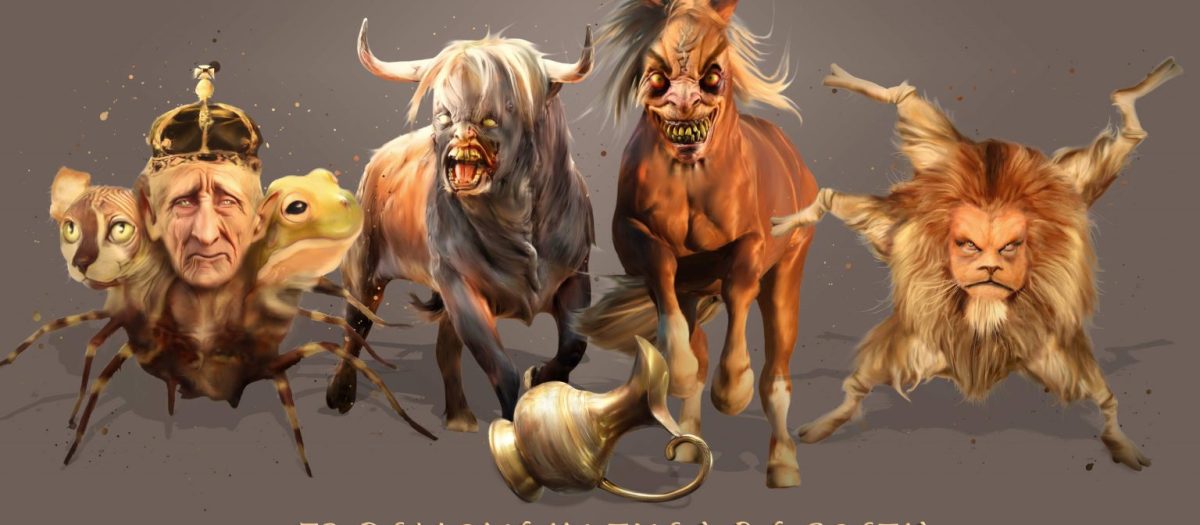
Quick answer: The Ars Goetia is the first section of the Lesser Key of Solomon (or Lemegeton), a collection of ceremonial magic texts preserved in seventeenth-century manuscripts. It describes 72 spirits, giving them names, ranks, symbols and attributed powers. These are claims made within a historical grimoire, not scientifically established beings or abilities. The text is important to the history of Western occultism and later demonology, especially through nineteenth- and twentieth-century editions.
Affiliate disclosure: Some links in this guide are affiliate links. Mystic Realm Blog may receive a commission if you make a purchase through them, at no additional cost to you.
Goetia is one of the most frequently discussed subjects in modern ceremonial magic, yet it is often described imprecisely. The word is sometimes used for any demon-related ritual, while popular videos present the 72 spirits as characters with a single unchanging mythology. The actual manuscript history is more complicated. Below we’ll examine the text, its sources, several commonly named spirits, the meaning of its seals and what historians can—and cannot—conclude.
What does the word Goetia mean?
The term is derived from Greek vocabulary associated with sorcery or magical practices, sometimes carrying negative connotations in ancient writing. In later European occult literature, goetia could refer to particular types of spirit conjuration. In the title Ars Goetia, it names a specific section of a much larger manuscript tradition. Using the term for all demonology or all forms of ceremonial magic obscures those distinctions.
Readers sometimes speak of “the Goetia” as though it were a person or a religion. It is better understood as a textual tradition: a collection of names, descriptions, ritual instructions and images copied and revised by historical authors and scribes. A reader can study it for its cultural influence without practising its rituals or believing that spirits can be compelled to appear.
What is the Lesser Key of Solomon?
The Lesser Key of Solomon, also known by its Latin title Lemegeton Clavicula Salomonis, is a compilation of magical material preserved in seventeenth-century English manuscripts. It is traditionally divided into five parts, including the Ars Goetia and other sections concerned with different magical systems. The first part, Ars Goetia, is particularly famous for its catalogue of 72 spirits.
The title attributes authority to King Solomon, the biblical ruler associated in later legend with wisdom and dominion over spirits. That is a literary attribution, not proof that Solomon wrote the seventeenth-century manuscripts. The relationship between biblical Solomon and the surviving grimoire is part of a much wider history of pseudonymous religious and magical texts.
- Ars Goetia: the catalogue of 72 spirits and descriptions of ceremonial conjuration.
- Ars Theurgia-Goetia: a separate section involving other classes of spirits and directions.
- Ars Paulina: material associated with angels and astrological divisions of time.
- Ars Almadel: ceremonial material involving an altar-like wax object and angelic names.
- Ars Notoria: a collection of prayers and figures, with its relationship to individual Lemegeton manuscripts varying.
When was the Ars Goetia written?
The surviving compilation is associated with the seventeenth century, but parts of its material are older. Spirit catalogues developed across medieval and early modern Europe, and manuscript copyists drew on earlier lists and stories. It is inaccurate to describe the complete Ars Goetia as a book personally written by Solomon in biblical times.
Joseph H. Peterson’s scholarly transcription of the Ars Goetia in the Lemegeton identifies British Library manuscript sources and traces connections with earlier printed catalogues. Among those precedents are Johann Weyer’s Pseudomonarchia Daemonum and material reproduced through Reginald Scot’s sixteenth-century work. Comparing versions shows how the tradition changed rather than remaining fixed from antiquity.
Why does the grimoire list 72 spirits?
The Ars Goetia’s best-known catalogue contains 72 named spirits. Each entry typically gives a name, rank, form, office or attributed ability and sometimes a seal. There are also references to numbers of “legions” and elaborate hierarchies. These belong to the language and structure of the grimoire and should not be mistaken for independently verifiable facts about invisible beings.
The number 72 has numerological associations in several religious and esoteric systems, which may help explain its appeal. Earlier spirit lists do not all contain exactly the same 72 figures. Some names vary in spelling or position between manuscripts and editions. If a website presents a rigid list as the one true ancient original, check which manuscript or edition it actually follows.
Which spirits are most frequently mentioned in the Goetia?
Bael: first in a familiar catalogue
Bael is commonly placed first in the Ars Goetia list and given the rank of king. Historical descriptions attribute unusual forms and powers to this figure. Such passages are best read as part of early modern magical literature: the text tells us what a particular writer believed or recorded, not that the described being has been demonstrated to exist.
Paimon: a named king in the text
Paimon is another prominent figure, usually ranked as a king and associated in the text with knowledge or instruction. Modern fiction and online communities have greatly expanded the character’s cultural visibility. The modern image of Paimon is not identical to every earlier manuscript account, and pop-culture adaptations should not be treated as primary historical sources.
Astaroth: an example of changing identities
Astaroth appears in spirit lists and demonological writing, with a name that invites comparison with older religious traditions and polemical reinterpretations. It would be too simple to treat every similarly named ancient deity and later demonological figure as identical. Historians examine linguistic connections, texts and the context in which a figure was described.
Stolas, Buer and Asmoday
Stolas, Buer and Asmoday are other familiar names, sometimes linked in the grimoire to astronomy, healing or other skills. Their appearances have become popular in art and media. Those attributed powers are part of the literary record; they are not reliable health advice or evidence of supernatural instruction. Differences between catalogues and editions also matter when comparing their ranks and descriptions.
What do the ranks and legions mean?
Kings, dukes, presidents, marquises and princes are titles attached to spirit entries. They resemble human political hierarchies and help organise the catalogue. A “legion” is a unit of followers within the narrative system. The ranks and counts can be compared across editions, but they should not be interpreted as census data for an unseen world.
These categories also show how early modern writers adapted familiar systems of authority to the supernatural stories they recorded. Looking at the structure can reveal the social assumptions embedded in the manuscript without requiring a belief in its literal cosmology.
What are Goetic sigils or seals?
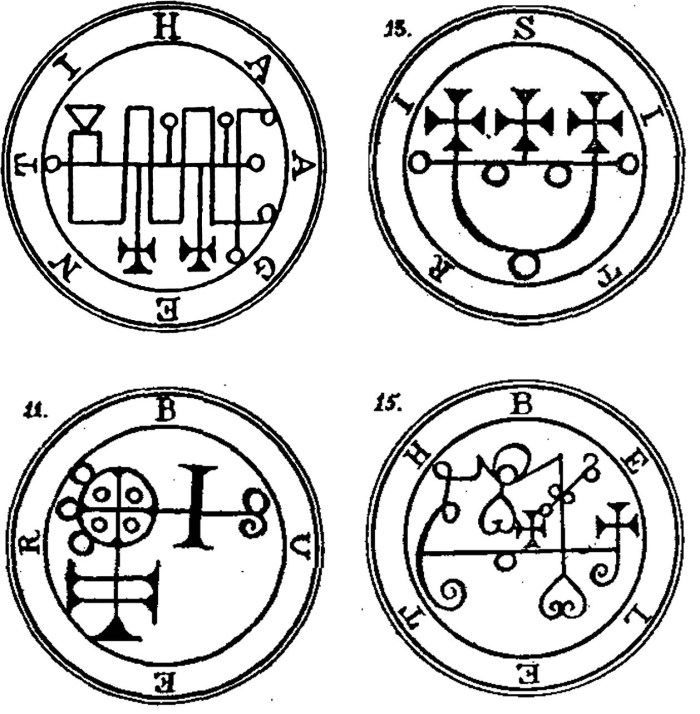
A sigil is a graphic mark associated with a particular spirit or magical intention. The Ars Goetia includes distinctive seals for many named figures, often copied in diagrams. Readers may encounter those shapes in jewellery, tattoos, fantasy art or modern magical manuals. Their appearance alone does not tell you what the owner believes or practices.
A major historical caution: not every seal reproduced on the internet can be traced to an ancient source. Manuscript illustrations may differ, and some sigils appear later than the earliest spirit catalogues. Instead of accepting a modern poster as an authentic “Solomonic seal”, compare it with documented manuscripts or editions. The Project Gutenberg edition of the Lesser Key is useful for comparison, though it reflects its own editorial history.
What do the ritual circle, triangle and brass vessel represent?
The text describes ritual spaces and objects such as a circle, a triangle, seals and a vessel. They form part of a ceremonial system intended by its authors to establish order and control. From a historian’s perspective, these details show how practitioners imagined authority and boundaries within ritual rather than demonstrating that the objects compel spirits.
These passages are best approached as primary-source material. Some instructions include elements that are unsafe or inappropriate to reproduce as a beginner activity. There is no need to conduct conjurations, burn hazardous materials or attempt rituals in order to understand the manuscript’s significance.
Is Goetia the same as demonology or exorcism?
Demonology broadly concerns beliefs and writing about demons, their nature and classification. Exorcism usually refers to rituals intended to expel an allegedly harmful spiritual presence in a religious context. Goetia names a particular magical and textual tradition. The subjects overlap in popular discussion but have different histories, goals and assumptions.
Our interview with Mike from The D.E.A.D. Institute offers a practitioner’s perspective on demonology and exorcism. That interview is a record of his views and experiences, not scientific verification of the supernatural claims involved. Treating interviews and historical documents as distinct kinds of sources helps readers understand what each can establish.
How did Aleister Crowley influence modern Goetia?
A widely circulated English edition of the Goetia was published in 1904 with material associated with S. L. MacGregor Mathers and Aleister Crowley. It helped introduce older manuscript traditions to new audiences of ceremonial magicians and later occult readers. Modern books often descend from, react to or reinterpret that publishing history.
For context about the person and his controversies, read our guide to Aleister Crowley. His involvement in publishing or interpreting a grimoire should not be taken as proof that its claimed spirits or effects were objectively verified.
Can you study the Ars Goetia without practising it?
Yes. You can compare translations, read about seventeenth-century manuscript culture and examine how religious ideas and political hierarchies shaped the spirit catalogue. This approach is especially useful if you enjoy folklore, literature or the history of Western esotericism. An annotated text that explains variant spellings and sources is a stronger starting point than dramatic lists without citations.
If you enjoy exploring sigil systems and ritual imagery, our occult symbols guide explains why the same mark can have different meanings across periods. You may also find the history of the Hermetic Order of the Golden Dawn useful for understanding later ceremonial magical influences.
Are Goetia rituals dangerous?
There is no reliable scientific evidence that Goetic names or seals summon real entities. Real-world risks can arise, however, from unsafe candles, smoke, intoxicants, sleep deprivation, distressing beliefs or pressure from other people. Avoid treating a grimoire as a substitute for medical, legal or mental-health advice. If something you read makes you anxious or afraid, take a break and seek ordinary support.
Beware anyone who demands money to “remove” a spirit or claims to have diagnosed a possession from online messages. Such claims are not verifiable and can exploit fear. Our hexes and curses guide covers similar issues of reassurance, scams and practical wellbeing.
Which Goetia books are worth reading?
For historical understanding, begin with a manuscript-informed edition that explains sources, variants and the difference between the Goetia and the larger Lemegeton. Avoid an edition that describes every story as proven fact. Readers interested in modern practice may encounter Demons of Magick by Gordon Winterfield, previously linked from this article. That is a modern interpretive approach, not a substitute for primary historical evidence.
Ars Goetia: frequently asked questions
What are the 72 demons of the Goetia?
They are the catalogue of named spirits described in the Ars Goetia, the first section of the Lesser Key of Solomon. Their attributed ranks and abilities belong to the grimoire’s traditional literature and have not been scientifically verified.
Did King Solomon write the Ars Goetia?
No historical evidence establishes that. The surviving compilation is associated with seventeenth-century manuscripts using the authority of Solomon as a literary attribution.
Are Goetia seals ancient?
Some come from manuscript traditions and later copies, and their dates and forms vary. Do not assume that every sigil circulating online was drawn in biblical times or even appears in the earliest known catalogue.
Is Paimon a real demon?
Paimon is a named figure in Goetic texts and modern popular culture. There is no reliable scientific evidence verifying the being’s literal existence or attributed powers.
Is Goetia another word for Satanism?
No. Goetia names a specific historical tradition of spirit conjuration. It should not be used as a blanket label for Satanism, all witchcraft or every form of demonology.
Where can I read the original Goetia?
Consult a documented manuscript transcription or annotated edition. Joseph H. Peterson’s online transcription and notes and the Project Gutenberg edition are two starting points, though their editorial bases differ.
Final verdict: a historically influential text, not a verified spirit directory
The Ars Goetia is worth studying for its manuscript history, symbolism and enormous impact on later occult culture. Its 72 spirits, sigils and ceremonial framework tell us about the beliefs and imaginations of the people who copied and read the text. They do not establish that the attributed entities can be summoned or commanded. Start with reliable editions, distinguish the Ars Goetia from the rest of the Lesser Key and continue through our guides to Aleister Crowley and occult symbolism.





[…] See Post on the Power of the Goetia here […]
[…] Check out our Post on The Demons of The Goetia Here […]