
Quick answer: Occult symbols are images or signs used to express ideas within esoteric, religious, magical and philosophical traditions. Examples include the pentagram, ouroboros, Eye of Providence, triquetra and Tree of Life. Their meanings depend on the time, culture and setting: there is no universal secret code that makes a particular shape inherently good, evil or supernatural. Several so-called occult symbols also have major non-occult religious meanings.
Affiliate disclosure: Some links below may be affiliate links. Mystic Realm Blog may earn a commission if you buy through them, at no extra cost to you.
Symbols can be fascinating because a simple design may appear in a medieval manuscript, an eighteenth-century engraving and a modern piece of jewellery. The temptation is to assume each use means exactly the same thing. That is often a mistake. This guide explores the best-known examples, their historical contexts, common misconceptions and how to identify an image before attaching a dramatic interpretation.
What makes a symbol occult?
The word occult refers broadly to something hidden or esoteric. In the study of Western esotericism it may involve alchemy, astrology, ritual magic and systems of philosophical correspondence. Symbols communicate ideas within those systems; for example, a planet might be represented by a particular mark, or a geometric pattern might be read as a diagram of balance.
That does not mean an image conveys one fixed message wherever it appears. A star decorating a building may be just an ornament. A similar star in a religious context could have an identifiable meaning, while a later occult author may reinterpret it. You need to know who created the object, when, and for whom before making claims about it.
Pentagram and pentacle: meaning and differences
A pentagram is a five-pointed star drawn with connected lines. Modern magical writers often call a star enclosed by a circle a pentacle, although the second word has also been used more broadly for a talisman bearing a mark. You may see the terms used inconsistently, so it helps to examine the image itself instead of relying on the label.
In some contemporary Wiccan and Pagan traditions the five points are assigned to earth, air, fire, water and spirit. The enclosing circle may be interpreted as protection or unity. These meanings are meaningful to practitioners, but they are not the only historical interpretations. A pentagram cannot tell you everything about its owner or their beliefs. For more context read Witchcraft for Beginners.

Does an upside-down pentagram mean Satanism?
An inverted pentagram appears in certain modern Satanic and occult designs, but it is misleading to read every upside-down star that way. Orientation has different implications in different traditions, and sometimes it is merely decorative. Historical meaning is established through a source or community, not by a universal rule that an image becomes sinister when turned around.
Ceremonial magicians also use pentagram symbolism in rituals such as the Lesser Banishing Ritual of the Pentagram. That practice is a modern tradition with a documented history; it does not prove that every pentagram has magical effects.
The Eye of Providence: what is the all-seeing eye?
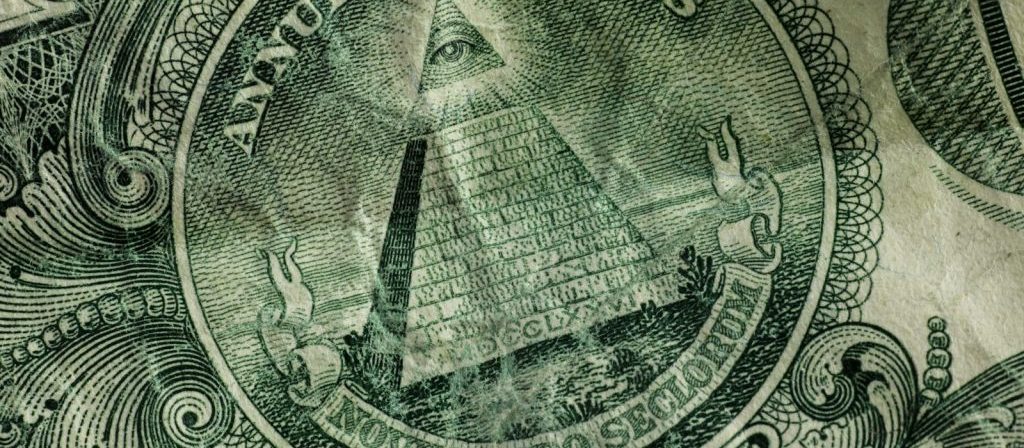
The Eye of Providence is commonly shown as an eye in a triangle or within rays of light. It has a documented history in European Christian imagery, in which it can represent divine awareness or providence. Forms of the all-seeing eye were later adopted by Freemasons, and the familiar eye above an unfinished pyramid appears on the reverse of the United States Great Seal and on the dollar bill.
Conspiracy explanations sometimes claim that any eye-and-pyramid image proves an Illuminati connection. This ignores the emblem’s documented religious and civic uses. Similarity alone cannot identify who made an image or what they believe. For historical context see The Eye of Providence and the Hamsa in Medicine, which discusses changing uses of eye motifs.

Is the Eye of Horus the same symbol?
No. The ancient Egyptian wedjat, or Eye of Horus, represents the restored eye of Horus and is associated with protection, healing and renewal. It is not simply another name for the European Eye of Providence. One may show stylised markings of a falcon’s eye, while the other often appears in a triangle with rays.
The Metropolitan Museum of Art’s wedjat amulet provides an actual dated Egyptian example. The myth links the restoration of Horus’s eye with Thoth. Looking at museum objects can tell us much more than treating two designs containing eyes as proof of a shared secret origin.
Ouroboros: the snake eating its tail
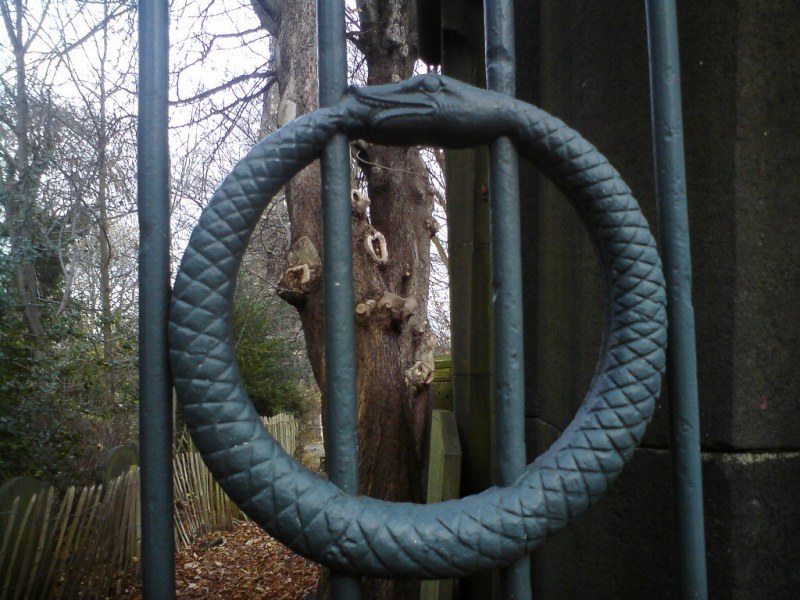
The ouroboros is a serpent, or sometimes a dragon, biting or swallowing its own tail to form a circle. Later interpretations often associate it with cyclical time, renewal, continuity and the joining of opposites. The design has a long and varied history, including uses in alchemical writing and symbolic art.
Describing it as an “ancient symbol of infinity” can be a useful shorthand, but it risks erasing differences between historical images. The interpretation attached to a particular ouroboros may depend on its surrounding text, the language of the manuscript and the author’s worldview. A modern tattoo or book cover may use it more freely.
Triquetra: a knot of three arcs
A triquetra features three interlaced arcs or corners. It appears in ornament, religious art and contemporary spiritual jewellery. Modern Pagan writers sometimes give it threefold meanings, while Christian uses can relate to the Trinity. It is not accurate to say that every historical triquetra was created with one specific modern Pagan interpretation in mind.
The history of a knot design should be studied where it appears. A manuscript border, a modern necklace and a carved stone may have related forms without identical meanings. Ask about the object’s origin before treating the motif as a coded ritual instruction.

Tree of Life: a shared phrase, different traditions
A tree linking earth and sky is a recurring motif in many forms of mythology. However, the Tree of Life in Jewish Kabbalah refers to a particular system of thought, often represented through the sefirot. It cannot be reduced to a generic New Age decoration without losing the substance of the tradition.
Later Western ceremonial magicians adopted and adapted versions of the Kabbalistic Tree of Life into their own correspondence systems. Those appropriations need to be distinguished from Jewish religious teaching. If you’re studying the Western esoteric reception, our Golden Dawn history offers additional background.

Hexagram and Star of David: what is the distinction?
A hexagram is the geometric form of a six-pointed star made from two overlapping triangles. The Star of David, or Magen David, has particular importance in Jewish identity and religious life. Although hexagrams have appeared in various contexts, that does not make the Star of David an inherently occult or sinister emblem.
Some esoteric writings use six-pointed stars or names such as the Seal of Solomon. Those sources should not displace the Jewish significance of the Star of David. The My Jewish Learning overview explains the historical development of the emblem and why its modern identity matters.

Baphomet and the goat-headed image
The now-familiar image called Baphomet is closely associated with the nineteenth-century French occult writer Éliphas Lévi. It combines several symbolic features that later artists and esoteric movements reinterpreted. Some internet accounts project this artwork backwards onto the medieval period as if the complete design had always existed. That is not supported by its documented history.
The name Baphomet also appears in older accusations and legends, but they cannot simply be equated with Lévi’s illustration. A drawing of a goat-headed figure is not proof that its owner practices demon worship or belongs to a particular organisation. As with other examples, historical context is essential.
Alchemy, planets and metal signs
Alchemical manuscripts employed signs for planets, metals, processes and substances. Familiar marks for the Sun, Moon, Mercury, Venus and Mars have also appeared in astronomy and astrology. An alchemist using a symbol for a metal might not mean what a modern astrologer or jewellery designer means by a similar mark.
You may see online charts claiming that every alchemical symbol has one eternal meaning. In reality the systems developed and varied across manuscripts and centuries. To study the history of alchemy’s connections to esoteric philosophy, see Hermeticism and Hermes Trismegistus.
Occult symbols at a glance
The same design may carry very different meanings depending on who uses it and when. This comparison offers starting points for research, not definitive labels that apply to every image. When in doubt, check the original object, its date and how the relevant community understands it.
| Symbol | Historical context | Modern associations | Important caution |
|---|---|---|---|
| Pentagram | Several decorative and esoteric settings | Modern Pagan and ceremonial magic | Not a universal sign of evil |
| Eye of Providence | European religious emblems | Masonic and civic imagery | Does not prove a secret society |
| Eye of Horus | Ancient Egyptian religious imagery | Amulets and popular jewellery | Different from the Eye of Providence |
| Ouroboros | Historical symbolic and alchemical traditions | Cycles and renewal | Meaning varies by source |
| Triquetra | Decorative and Christian contexts | Modern Pagan jewellery | Not every historical use was Pagan |
| Tree of Life | Jewish mystical teachings and other tree motifs | Western esoteric adaptations | Do not collapse distinct traditions |
| Star of David | Jewish religious and cultural identity | Jewish emblems and flags | Not inherently occult or sinister |
| Baphomet | Nineteenth-century occult illustration | Modern art and occult iconography | Not proof of an ancient goat cult |
How should you research an unfamiliar symbol?
First describe what you can actually see: shape, number of points, inscriptions and accompanying figures. Next identify the object’s place, approximate date and likely audience. A museum catalogue or a book reproducing the original manuscript is much better evidence than an unattributed collage. Compare how the symbol was used by people within the relevant religious or cultural tradition.
Then distinguish the historic meaning from later reinterpretations. A seventeenth-century Christian use, a nineteenth-century Masonic use and a modern internet theory might all involve a similar eye image; none automatically validates the others. Finally, avoid inventing secret meanings for people or communities who do not claim them themselves.
The same approach can improve the way you read about Goetia, witchcraft for beginners and other traditions. The more specific your sources, the more interesting the real history becomes.
Occult symbols: frequently asked questions
Do occult symbols have supernatural powers?
People sometimes use signs as expressions of spiritual meaning or personal intention, but no reliable scientific evidence shows that drawing or wearing a particular symbol causes supernatural events. Historical significance should not be mistaken for a measurable physical effect.
Is the pentagram always a symbol of evil?
No. Its uses include decoration and several religious and magical traditions. Orientation, location and historical context all matter, and a star alone cannot tell you someone’s beliefs.
Why is the eye on a US dollar bill?
It forms part of the reverse of the Great Seal of the United States, which uses an eye above an unfinished pyramid. The emblem has documented civic and religious symbolism; it is not by itself evidence of a hidden organisation controlling money.
Is the Star of David an occult sign?
It is first and foremost an important emblem of Jewish identity. The six-pointed geometric form has also appeared in other settings, but modern occult interpretations should never erase the Jewish meaning or turn it into a conspiracy motif.
Are all occult symbols ancient?
No. Some motifs are old, but particular combinations and explanations may be modern. Confirm whether an author is describing an actual archaeological object, a later manuscript or a recent adaptation.
Where can you learn more?
Choose books that reproduce historical objects, give dates and explain which culture or tradition is being discussed. The original version of this post included an optional reference-book affiliate listing; check the current title and author before buying. Our magick books guide also provides further reading.
Final verdict: meaning depends on history
Occult symbols are not a universal secret alphabet. Their meaning comes from people, texts and traditions. A pentagram, ouroboros, triquetra or Tree of Life can be richly significant without proving an extraordinary claim. Begin by identifying the actual design and its history, then compare later interpretations fairly. For related study, explore the LBRP, Hermeticism and Witchcraft 101.